I Skipped My Own Rent to Save My Best Friend’s Dream
Rui texted me at eleven at night: I need four hundred euros by tomorrow or I lose the stall.
I read it twice before I even sat up in bed. Lisbon in October gets cold fast once the sun drops, and my studio near Rua de São Tomé still smelled like the ginjinha we’d drunk earlier that week at a bar in Alfama, laughing about nothing.
Trending Now!!:
Rui and I had known each other since we were fifteen, back when we used to skip PE class and sit on the steps near Miradouro de Santa Luzia, watching the trams groan up the hill.
He was the kind of friend who remembered your coffee order and your worst breakup in the same breath. He’d started a small stall at Feira da Ladra six months earlier, selling handmade leather bags he stitched himself in his mother’s kitchen. He called it his side hustle income, the thing that was finally going to get him out from under his restaurant job.
I called him instead of texting back.
What happened to the stall, I asked.




The market association raised the weekly fee, he said, his voice tight in a way I hadn’t heard since his father’s funeral. If I don’t pay by tomorrow morning, they give my spot to someone else. Two years of building a name there, gone. I’m this close, Inês. I swear I’m this close to actually making it work.
Four hundred euros was exactly what I had set aside for my own rent, due in six days. My landlord did not care about anyone’s stall or anyone’s dream. He cared about the transfer landing on the first of the month, every month, no excuses.
I told Rui I needed to think.
He went quiet on the other end, and in that silence I could hear every conversation we’d ever had about financial freedom, about how neither of us wanted to end up like our parents, tired and broke at sixty with nothing to show for it. I could hear the version of myself that believed in him completely, and the other version, smaller and more tired, that had already lent him money twice before and never once seen it come back.
I’ll have it for you by nine, I said.
The next morning I walked to the ATM near Praça do Comércio with the river throwing that flat silver light across the water, the kind Lisbon does so well in autumn. I withdrew the money and felt something crack quietly in my chest, some private agreement with myself I was breaking without fully admitting it.
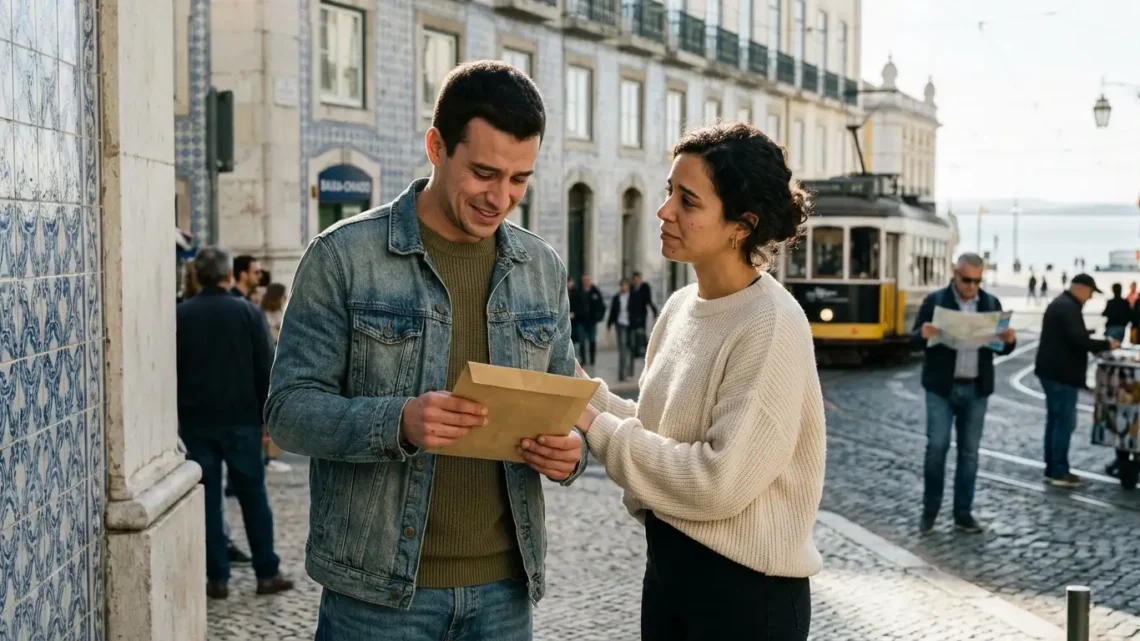
Rui met me outside the metro at Baixa-Chiado. He looked like he hadn’t slept. When I handed him the envelope his hands were shaking, and for a second I almost forgot about the rent entirely, because his relief was so real it filled the whole street.
I won’t forget this, he said. I’m paying you back the second the weekend sales come in. I promise on my mother.
I believed him. I always believed him, that was the whole problem.
Three days passed. Then five. I texted him twice, casual at first, just checking in, then a little more pointed. He replied with a string of excuses that got thinner each time: a supplier delay, a slow weekend, a cousin’s wedding that ate into his savings. On the fifth day I walked to Feira da Ladra myself, weaving through the tables of old vinyl records and mismatched cutlery, and found his stall closed anyway. A woman selling ceramics next to his empty spot told me he hadn’t shown up in three days.
I stood there in the middle of the market with my rent due in one day and my best friend nowhere to be found, and I felt something I didn’t expect. Not rage exactly. Something closer to grief.
That night I finally reached him. His voice sounded far away, like he was somewhere loud.
Where are you, I asked. Where’s my money, Rui.
I’m sorry, he said. I used it for something else. I’ll explain everything, just not right now.
I asked him what could possibly matter more than what he’d promised me, more than the rent I now didn’t have, more than two years of friendship built on steps and cheap ginjinha and every hard conversation two people can have with each other. He didn’t answer. He just kept saying sorry, over and over, until the word stopped meaning anything at all.
I found out two weeks later, from his sister, that there had been no market fee, not really. Rui had used the money to cover a gambling debt from an online betting app he’d been quietly feeding for months, the kind of thing you don’t mention to the friend who thinks you’re building a leather goods empire out of your mother’s kitchen. The stall closing had been true. Just not for the reason he told me.
I sat with that for a long time. I thought about calling him to scream, to demand every euro back with interest, to tell him exactly what kind of person lets a friend go without rent money for a lie dressed up as a dream. Instead I just stopped answering his messages. No dramatic goodbye. No final confrontation on the steps where we used to sit. Just silence, the kind that says everything without needing a single word.
My landlord gave me an extra week when I explained, more grace than I expected from a man who usually cared about nothing but the transfer date. I picked up two extra shifts at the café near Rossio to cover the gap, and somewhere in those long, tired weeks I thought a lot about boundaries, about the difference between loving someone and letting them use that love as a line of credit.
Rui still messages sometimes. Short things. Happy birthday. Saw this and thought of you. I read them and I don’t reply, and I don’t fully know why. Maybe I’m still deciding whether some friendships are worth rebuilding from the ground up, or whether some things, once they crack, just stay cracked no matter how much you want to believe otherwise.
I still walk past Feira da Ladra sometimes on Saturdays. His spot belongs to someone else now, a young woman selling secondhand records. I don’t know if I miss him or just miss who I thought he was.
Some debts get repaid. Some just get carried.