
I Visited My Aging Dad Every Sunday in Lagos, But I Never Realized It Was Countdown
The heavy traffic on Bode Thomas Street honked in a relentless rhythm that afternoon in Lagos, Nigeria.
Adewale sat behind the steering wheel of his dusty sedan, wiping sweat from his forehead with the back of his hand. The air conditioning blew only warm air, smelling faintly of old dust and burnt fuel.
Trending Now!!:
Outside, hawkers dodged between idling cars, balancing trays of chilled bottled water and roasted plantain chips on their heads. Adewale checked his wristwatch for the third time in five minutes. He was late, and time was the one currency he could no longer afford to waste.
He pulled up in front of the faded yellow duplex where Pa Tunde had lived for thirty years. The iron gate groaned on its rusted hinges as Adewale pushed it open and walked into the courtyard.
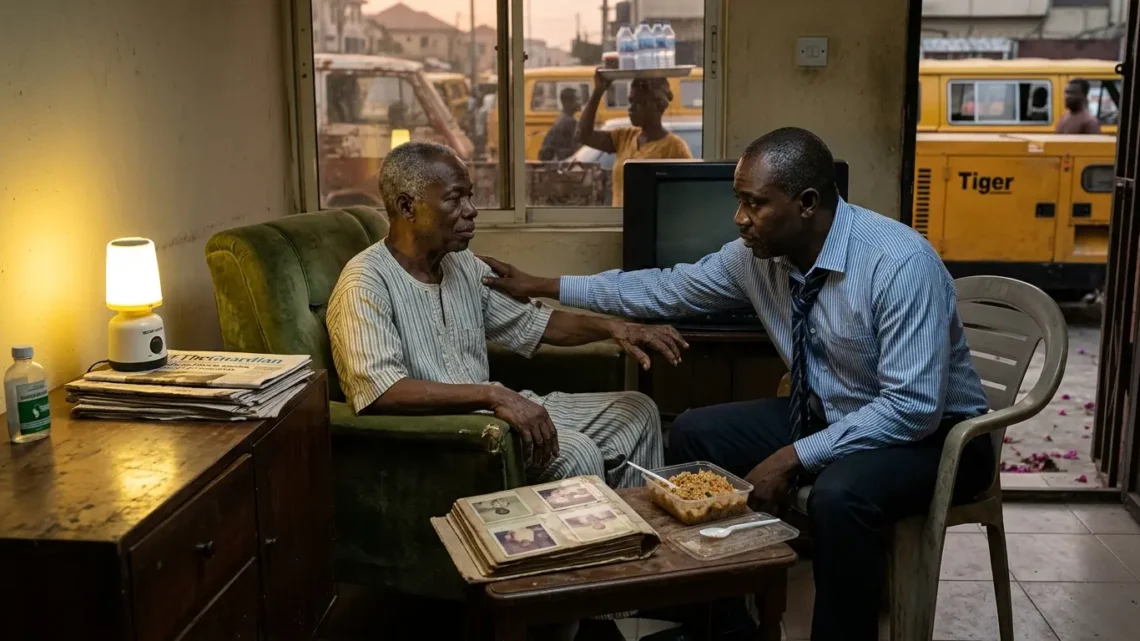
Bougainvillea petals littered the cracked concrete pavement, swept into corners by the dry harmattan wind. Inside the house, the ceiling fan whined in slow, pathetic rotations against the afternoon heat. Pa Tunde sat in his usual green armchair by the window, staring blankly at a television that was not even plugged in.
You took your time, Pa Tunde said without turning his head. His voice was thinner than it had been last month, brittle like dry parchment.




Adewale dropped his car keys onto the wooden side table with a sharp clatter. I ran into terrible gridlock near Ojuelegba, Baba, Adewale replied, loosening his tie as he walked over. The trailers blocked the entire bridge.
Pa Tunde nodded slowly, his gaze drifting back to the blank screen of the television. Gridlock is the only constant thing in this Lagos.
The living room smelled of eucalyptus balm and old paper, the scent of a life slowly packing itself away. Adewale looked around at the framed photographs hanging crookedly on the walls.
There was Pa Tunde looking sharp in a crisp suit in 1985, standing beside Mama Adewale before her hair turned silver. There was Adewale himself as a boy, holding a school prize he barely remembered winning.
Simi, his younger sister, had taken most of the newer family albums to London when she relocated two years ago. Pa Tunde had refused to go with her, insisting his roots were too deep in Nigerian soil to transplant.
Are you hungry? Adewale asked, breaking the quiet that had settled over the room. I brought fried rice from the eatery down the road.
Your mother used to cook fresh pepper soup on Sundays, Pa Tunde murmured, finally looking up. Real pepper soup with fresh catfish from Makoko market. Not this modern takeaway food.
I know, Baba, Adewale said softly, opening the plastic container and pulling out a disposable spoon. Nobody cooks like she did.
They ate in near silence, punctuated only by the distant sound of a generator struggling to power the neighborhood. Adewale watched Pa Tunde move his food around the plastic plate with trembling fingers.
The man who had once run a bustling auto-parts business in Idumota market now struggled to lift a spoonful of rice. Age did not arrive with a sudden crash; it crept in through tiny concessions and shrinking boundaries.
Adewale felt a familiar knot tighten in his chest, a mix of guilt and helpless frustration. He visited every Sunday, yet every Sunday felt like an audition for a goodbye he was not ready to stage.
How is your work at the bank? Pa Tunde asked, chewing slowly. They are not stressing you too much?
Target pressures are always there, Baba, Adewale said, forcing a reassuring smile. We manage.
Do not kill yourself for a company that will replace you by Monday, Pa Tunde warned, pointing his spoon for emphasis. I spent my whole life building that warehouse. When my legs failed, they forgot my name within six months.
Adewale nodded, though he heard the familiar speech with the dull ache of repetition. He lived on his laptop, fueled by endless cups of instant coffee and the constant hum of Slack notifications.
His phone buzzed in his pocket with a work email he desperately wanted to ignore. He resisted the urge to check it, knowing that looking at the screen would break whatever fragile bridge remained between him and his father. Instead, he reached for a dusty photo album resting on the lower shelf of the coffee table.
Look at this, Adewale said, flipping open the heavy cover. Remember when we traveled to Badagry for that wedding?
Pa Tunde leaned forward, his eyes brightening momentarily as he peered at the faded polaroid. Ah. Your uncle Bode wore that ridiculous yellow agbada. Everyone laughed at him.
And it rained so hard the car got stuck in the mud, Adewale added, a genuine laugh escaping him. We had to push for an hour.
That was a good day, Pa Tunde whispered, tracing the edge of the photograph with a thumb that bore permanent grease stains from decades past. Before the bills. Before the hospital visits.
They spent the next hour turning pages through decades of birthdays, naming ceremonies, and funerals. For a brief span, the apartment felt full again, crowded with ghosts and memories that refused to fade entirely.
Adewale realized how rarely they simply sat and looked backward. Life demanded constant motion, pushing everyone forward into new deadlines and rising rents. Pausing to remember felt like a luxury reserved for people with nothing left to lose.
As the afternoon sun began to dip below the horizon, casting long orange shadows across the tiled floor, the generator outside sputtered and died. The sudden quiet was absolute, broken only by the chirping of geckos behind the curtains.
Adewale stood up to switch on the rechargeable lamp on the sideboard. The yellow glow illuminated the gray hairs at Pa Tunde temples and the deep lines etched around his eyes.
You should go before dark, Pa Tunde said quietly, staring straight ahead. The traffic on the mainland will become impossible.
I can stay a bit longer, Baba, Adewale offered, though he knew he had laundry waiting and a morning presentation to prep.
No. Go home to your apartment, Pa Tunde insisted, his tone gentle but firm. Do not spend your entire Sunday sitting in an old man’s house.
Adewale packed up the empty food containers and wiped the table clean. He walked over to the armchair and placed a hand on his father’s fragile shoulder.
Pa Tunde covered Adewale hand with his own, patting it twice with dry, papery skin. They did not say anything else; words were never their strong suit anyway.
He walked out into the courtyard, pulling the heavy iron gate shut behind him with a dull metallic clang. The evening air of Lagos hit him immediately, thick with the scent of roasted corn and exhaust fumes.
Adewale unlocked his car, climbed inside, and sat for a moment in the dark cabin before turning the ignition. He looked up at the lit window of the duplex, where an old man sat alone in the fading light.
He shifted the car into gear and drove out into the chaotic street, carrying the heavy, unspoken weight of another Sunday gone.
We spend our lives running toward tomorrow, forgetting that the people who made us are slowly turning into yesterday.