I Was Blamed for the Email Everyone in the Office Was Afraid to Send
Marta was standing outside the conference room in Warsaw when her boss asked why she had sent an email she had never seen.
The strange part was that the email had her name on it.
Trending Now!!:
Her phone was at 14 percent. Her coffee had gone cold. Somewhere behind the glass door, twelve people were waiting for her to explain something she could not explain.
I did not send that, Marta said.
Her manager, Piotr, looked at the laptop in his hands.
The system says you did.




That was how Marta spent a perfectly normal Wednesday morning in an office near Warsaw’s Rondo ONZ, trying to defend herself against an email she had apparently written at 2:13 in the morning.
The email had gone to the company director, the finance department, and the head of sales. It accused the sales team of hiding expenses and called one senior employee, Tomasz, incompetent.
Nobody in the room seemed shocked by the word incompetent.
They were shocked because Marta was normally the person who stayed late to fix other people’s mistakes.
She worked in operations for a logistics company. Her job sounded important when she explained it to relatives, but most days it meant spreadsheets, delivery schedules, invoices, missing signatures, angry clients, and messages beginning with urgent.
She had become very good at answering questions that should never have reached her.
Where is the shipment?
Who approved this?
Why is the invoice wrong?
Can you resend the attachment?
Did anyone check the address?
Her real talent, however, was remembering small things.
She knew which printer jammed after twenty pages. She knew that Piotr hated phone calls before nine in the morning. She knew Tomasz always forgot his access card on Fridays.
She also knew that nobody in the company ever admitted making a mistake until the mistake had become too large to hide.
That morning, the mistake was hers.
At least, according to the computer.
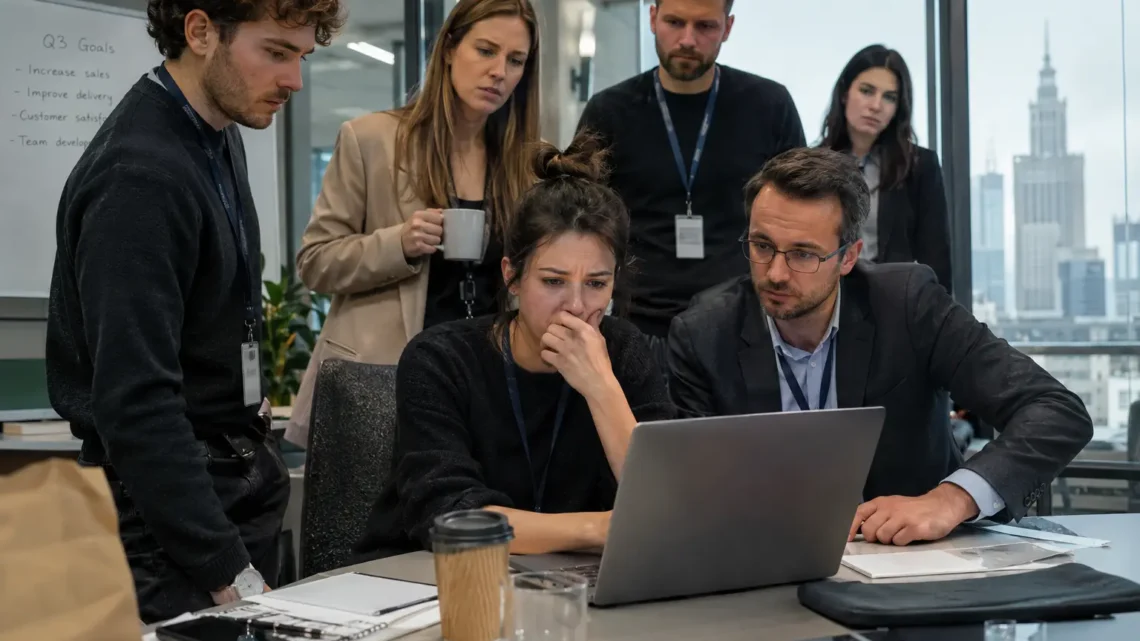
Marta sat down at the end of the conference table.
Piotr connected his laptop to the screen.
The email appeared.
It had been sent from Marta’s company account at 2:13 a.m.
The subject line was simple.
We Need to Talk About What Is Happening Here.
The first paragraph complained about missing expense receipts.
The second accused Tomasz of shifting responsibility onto junior employees.
The third said management had created a workplace where people were afraid to speak honestly.
Then came the sentence that made Marta want to disappear.
Some of us are tired of pretending this is normal.
Everyone looked at her.
She looked at the screen.
I would never write that, she said.
Piotr folded his arms.
Would you write something similar?
Marta stared at him.
That was the problem.
She might have thought it.
She had definitely thought it.
She had just never written it.
For three months, the office had been under pressure because the company had lost two large clients. Salaries were still being paid, but overtime had quietly become expected. People stopped leaving at five. Lunch became something eaten while looking at a screen.
One colleague had resigned without telling anyone until the day before she left.
Another had started working from a café because he said he could no longer concentrate in the office.
Nobody called it burnout.
They called it a busy period.
Marta had started searching online for career growth tips late at night, not because she wanted a promotion, but because she was trying to work out whether every workplace eventually became like this.
The night before the email appeared, she had left the office at 7:48 p.m.
She remembered because she had checked the time while waiting for the lift.
She had stopped at a small grocery shop near Świętokrzyska station and bought bread, milk, cheese, and a packet of chocolate biscuits.
That packet mattered later.
At home, Marta had eaten two biscuits while watching half an episode of The Bear.
Then she had fallen asleep on the sofa.
Her laptop was in her bedroom.
She had not touched it again.
At least, that was what she believed.
After the meeting, Piotr asked her to stay behind.
The others left slowly.
Tomasz paused at the door.
For what it is worth, I believe you, he said.
Marta almost laughed.
That makes one of us.
He smiled awkwardly and left.
Piotr remained standing beside the screen.
I am not saying you are lying, he said. I am saying the system says your account sent it.
Then the system is wrong.
Systems are rarely wrong in ways that are this convenient.
That sentence stayed with her.
By lunchtime, half the office knew.
Nobody asked Marta directly.
People communicated the way office workers always do when something embarrassing is happening. They sent private messages.
Are you okay?
What actually happened?
Was it really you?
Do not panic.
One person sent a five-minute voice note and then deleted it.
Another simply wrote:
Girl.
That was somehow worse.
At 1:30 p.m., Marta went downstairs to buy lunch.
Warsaw was cold enough that people had started wearing coats again. Trams moved past along Aleje Jana Pawła II, and commuters crossed the pavement with their heads down.
She bought pierogi from a small place she sometimes visited.
While waiting, she opened her banking app.
Her salary had arrived.
For a few seconds, she stared at the number.
Rent.
Transport.
Food.
Utilities.
The usual list appeared in her head.
She had spent months telling herself that financial freedom was something people talked about online because they had never seen a real electricity bill.
She put the phone away.
Her problem was not money.
Her problem was that she might lose the job that paid it.
At 3:17 p.m., the IT technician finally called.
His name was Kamil, and he had the calm expression of someone who had spent years watching people blame computers for human behavior.
I found something, he said.
Marta sat up.
What?
Your account was used from another device.
Her stomach tightened.
Whose device?
That is the problem. We do not know yet.
He showed her the access record.
There had been a login shortly after midnight.
Then another at 2:13 a.m.
The second one sent the email.
Marta remembered something.
Her laptop.
She had left it unlocked in the office.
Not overnight.
Just briefly.
At 7:31 p.m., she had gone to the kitchen to make coffee.
Anyone could have walked past her desk.
She thought about the office.
The empty desks.
The half-eaten snacks.
The shared printer.
The open-plan floor where everyone could see everyone but somehow nobody knew what anyone was doing.
Then she remembered the biscuits.
At 7:35 p.m., she had placed the packet beside her laptop.
When she returned from the kitchen, two biscuits were missing.
She had assumed Tomasz took them.
He had a habit of taking food from people’s desks and claiming he was helping with inventory.
It was such a small thing that she had forgotten it.
Until now.
Marta walked back upstairs.
Tomasz was sitting at his desk.
She stood beside him.
Did you use my laptop last night?
He looked up.
No.
Did you take my biscuits?
He blinked.
What?
The biscuits.
He stared at her for several seconds.
Then he laughed.
You think I wrote that email because I stole two biscuits?
She did not laugh.
He stopped.
Okay. That sounded bad.
Marta crossed her arms.
I am serious.
Tomasz looked around the office.
Then he lowered his voice.
I did use your laptop.
The room seemed to become quieter.
Why?
I needed to open a file.
You could have asked me.
You were gone for two minutes.
That is not the point.
He rubbed his forehead.
I opened the file. Then I went back to my desk. I did not send anything.
Marta looked at him.
Did you leave the browser open?
I do not know.
She walked away.
An hour later, Kamil found the rest.
Someone had accessed Marta’s account through the browser session on her computer.
The email had been drafted earlier.
Not at 2:13.
The draft had been created at 7:42 p.m.
Someone had opened it later and pressed send.
There was no way to prove who had done it.
Security cameras covered the corridor, but not every desk.
Several people had walked through the area.
Tomasz admitted he had been there.
So had Piotr.
So had two other employees.
The investigation ended with an uncomfortable sentence from management.
We cannot determine who sent the email.
Nobody was fired.
Nobody apologized.
The email itself remained in everyone’s inbox.
That was the part Marta found hardest.
For weeks afterward, people treated her differently.
Some thought she had written it and escaped punishment.
Others thought she had been framed.
A few secretly agreed with every word.
One Friday evening, Piotr called her into his office.
He closed the door.
I want to ask you something, he said.
Marta waited.
Was the email wrong?
She looked at him.
The office was nearly empty.
Outside the window, Warsaw lights were coming on one by one.
I do not know, she said.
Piotr nodded.
That is not what I expected you to say.
She smiled.
Maybe that is the problem.
He did not respond.
On Monday, Marta arrived ten minutes early.
She opened her laptop.
She checked her email.
She checked her calendar.
Then she opened a new document and typed out everything she had wanted to say for months.
She did not send it.
She saved it.
The file name was simply: Things I Should Have Said Earlier.
At 5:02 p.m., Tomasz walked past her desk.
He stopped.
You leaving?
Not yet.
He pointed at her desk.
There was a fresh packet of chocolate biscuits beside the laptop.
He smiled.
Those are yours?
Marta looked at him.
Very funny.
He took one anyway.
She let him.
Nobody ever found out who sent the email.
The strange thing was that, after everything, Marta stopped caring quite as much about the person who pressed send.
She cared more about how many people had read it and quietly thought, yes, finally.
Sometimes the most dangerous email in an office is the one nobody wants to admit they secretly agreed with.