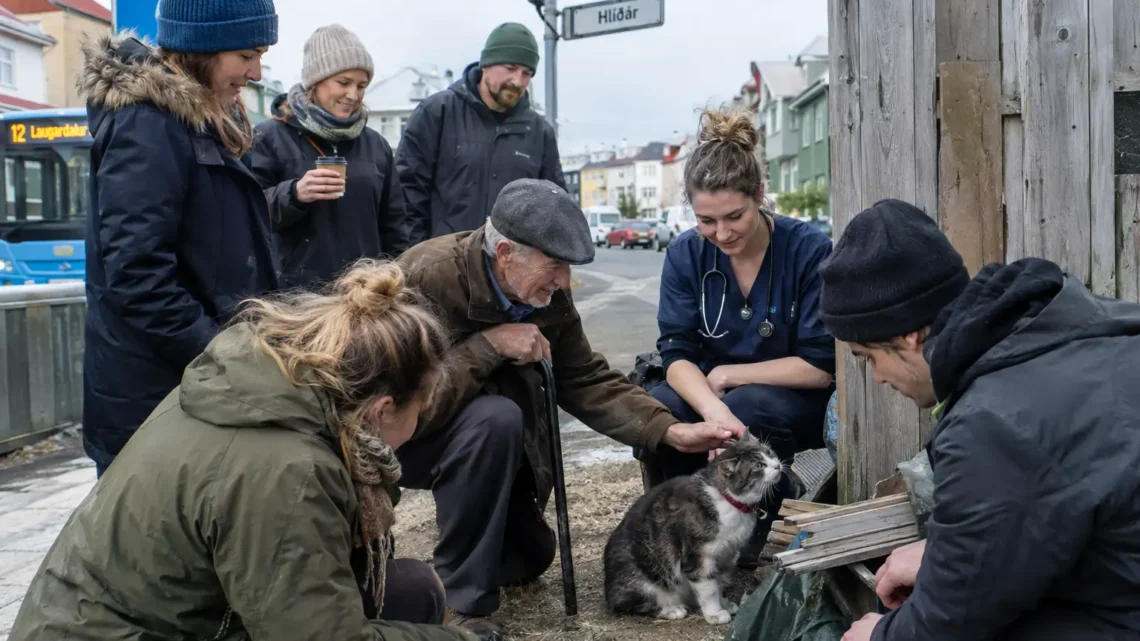
Nobody Claimed the Cat, So I Took Him Home. Then I Learned His Secret
The cat had been sitting on the bus for three stops before anyone admitted it was probably lost.
I was on the number 12 bus in Reykjavík, heading toward Laugardalur with a paper bag of groceries between my shoes, when the driver glanced at the mirror and said, Is that cat supposed to be here?
Trending Now!!:
Nobody answered.
The cat was sitting on the seat behind me.
It was a large grey-and-white thing with one torn ear, yellow eyes, and the expression of someone who had paid rent in Reykjavík for years and was tired of everyone asking questions. It was wearing a red collar, but there was no tag.
A woman across the aisle looked at it and laughed.




Maybe it has a bus pass.
The driver shook his head.
I am not charging it.
That was how Móri came into my life.
At least, that was what I called him later.
At the time, I did not know his name.
The driver pulled over near Laugardalur and opened the doors. The cat did not move. People got off around it. A teenager stepped around its tail. An older man stopped, looked at the cat, then looked at the driver.
He gets off here?
Apparently not, the driver said.
The doors closed.
We drove another two blocks.
The cat remained.
I turned around and held out my hand.
Come here.
The cat looked at me.
Then it looked out the window.
I felt stupid.
Fine.
It was not my cat. I had never owned a cat. I was renting a small flat near Hlíðar, and my landlord had made it very clear that pets were not part of the agreement.
Still, when the bus reached the next stop, the cat suddenly jumped down, walked to the door and waited.
The driver opened it.
The cat stepped off.
I stepped off too.
I had no reason to.
That was the first mistake.
The second was following him.
He walked through a quiet residential street as if he knew exactly where he was going. Reykjavík has a way of making ordinary things look slightly unreal. The houses are bright, the streets are clean, and beyond them you can sometimes see mountains or a strip of sea. Even a badly parked car can look dramatic against the sky.
The cat walked past a bakery, crossed carefully at a pedestrian crossing and stopped outside a small apartment building.
I stood across the road.
The cat looked back at me.
You live here?
He ignored me.
A woman came out carrying a rubbish bag. The cat rubbed against her legs.
She looked down.
Oh, hello again.
Again.
That word stayed with me.
I crossed the street.
Do you know this cat?
The woman nodded.
Everyone knows him.
Does he belong to you?
She laughed.
No.
That seemed strange.
She pointed down the street.
Ask Einar. He feeds him sometimes.
So I went looking for Einar.
That was how I learned the most important thing about Reykjavík’s most confusing cat.
Nobody owned him.
At least, nobody thought they did.
Einar lived three buildings away. He was in his late seventies, according to the woman, and spent most mornings walking slowly to the corner shop with a cane.
When I found him, he was sitting on a bench outside his building.
I showed him a picture I had taken of the cat.
He smiled immediately.
That old troublemaker.
You know him?
Of course.
What’s his name?
Einar shrugged.
Depends who you ask.
Apparently, one neighbour called him Gráni. Another called him Kisa. A child in the building had named him Batman. Someone else called him Móri.
That was the name I liked.
Does he have an owner?
Einar looked toward the street.
He used to.
That answer changed the conversation.
I waited.
Einar tapped his cane against the pavement.
An old woman lived here. Sigríður. She had him for years. When she went into a care home, the family took her dog. Nobody wanted the cat.
He said it without anger.
Just tiredness.
So he became everyone’s cat.
I looked down the street.
Móri was sitting outside a parked car, washing one paw.
Does anyone feed him?
Einar laughed.
Everyone.
That was the problem.
For the next few weeks, I kept seeing him.
Outside the supermarket.
Near the swimming pool.
Behind the bakery.
Once, he was asleep on a folded jacket outside a bicycle shop.
I started taking pictures.
Not because I planned to do anything with them. I just found his confidence funny. He walked through the neighbourhood like a retired mayor who had somehow lost the election but kept the office.
I posted one photo in a local Facebook group.
Within an hour, twelve people commented.
He belonged to someone.
He did not belong to anyone.
He had been abandoned.
He had escaped.
He was old.
He was not old.
He hated children.
He loved children.
He slept in a garage.
He slept in three garages.
One person said he was called Móri.
Another said that was completely wrong.
Then a woman named Helga sent me a private message.
She wrote that she had been feeding him for almost four years.
I met her at a café near Laugavegur the next day.
She told me she had a photograph of Móri sitting beside Sigríður years earlier.
The cat looked almost exactly the same.
She loved him, Helga said.
Then why did nobody take him?
Helga stirred her coffee.
Her family lived outside Reykjavík. They tried. He came back.
How?
I don’t know.
That answer bothered me.
I began asking questions.
Not dramatic questions. Just ordinary ones.
Where did he sleep?
Who took him to the vet?
Who bought his food?
Who paid when he needed medicine?
The answers were uncomfortable.
Everyone cared about him.
Nobody was responsible for him.
That distinction became very real one Thursday evening.
Móri had been missing for almost two days.
At first, nobody worried.
Cats disappear.
He probably found somewhere warm.
Then Helga posted in the neighbourhood group asking if anyone had seen him.
People replied quickly.
No.
Not since Tuesday.
Maybe he was under a car.
Maybe he was at the harbour.
Maybe someone had taken him.
Someone suggested calling animal services.
Another person said they had already called.
That was when the neighbourhood changed.
People who had spent years assuming someone else would deal with Móri suddenly had to decide whether they actually would.
I walked around Hlíðar after work calling his name.
It felt ridiculous.
Móri.
Nothing.
Móri.
A man passing with a shopping bag looked at me.
Lost your cat?
Not exactly.
He smiled.
That’s what everyone says about him.
It was getting dark when I heard a faint scratching sound.
It came from behind a storage building.
I crouched down.
There he was.
Móri was trapped behind a wooden gate.
He was wedged between a fence and some stacked building materials. One back leg was caught under a loose board.
He looked at me as if I had personally arranged the entire situation.
What did you do?
He blinked.
I called Helga.
Then I called Einar.
Then I called the vet.
Within twenty minutes, four people were standing in the cold behind that building.
Nobody knew who was actually responsible for getting him out.
That became the argument.
Helga wanted to lift the board.
Einar said it might hurt his leg.
Another neighbour wanted to call animal rescue.
A younger man said he had tools in his car.
Everyone had an opinion.
Nobody had a plan.
Finally, Einar sat on the ground.
He looked at the cat and said quietly, Easy, old friend.
Móri stopped struggling.
The younger man lifted the board.
I reached underneath.
Móri bit my glove.
Thank you, I said.
We got him free.
He stood there for several seconds.
Then he walked directly toward Einar and sat beside his shoe.
Nobody spoke.
Einar bent down and scratched his head.
You are a lot of trouble.
Móri closed his eyes.
We took him to the vet.
Nothing was broken. He had a swollen leg and a small cut. The vet cleaned it, gave him medicine, and told us he needed somewhere warm and quiet for a few days.
Then came the awkward part.
Whose cat is he? the vet asked.
We looked at one another.
Nobody answered.
The vet looked at me.
You brought him in.
That doesn’t mean he’s mine.
She smiled.
It often starts that way.
I laughed because I did not know what else to do.
That night, I took Móri home.
I broke the landlord’s rule.
Technically.
He slept on my sofa for three nights.
He hated the medicine.
He hated the carrier.
He loved the window.
On the second night, he climbed onto my chest while I was watching The Bear and fell asleep there.
I barely moved for two hours.
The next morning, I posted another picture.
Móri is safe.
The comments exploded.
People offered food.
Someone offered to pay the vet bill.
A woman said she would take him permanently.
Another person said Móri had lived freely for years and should stay that way.
Then Einar came to my flat.
He stood at the door with his cane.
You know what Sigríður used to say?
I shook my head.
She said Móri didn’t belong to her.
He looked at the cat sleeping beside the radiator.
She said she belonged to him.
I laughed.
Then I didn’t.
A week later, Móri went back outside.
There was no ceremony.
No adoption papers.
No announcement.
He simply walked out of my building one morning and disappeared around the corner.
For several days, I worried.
Then I saw him near the bakery.
He was sitting beneath a parked car.
Helga was feeding him.
Einar was standing nearby.
A child was trying to touch his tail.
Móri looked completely satisfied with himself.
I asked Einar whether we should make someone officially responsible for him.
He thought about it.
Maybe.
Then he looked at the cat.
Maybe that would ruin everything.
I still see Móri sometimes.
There is now a small group chat for people who know where he has been spotted. Nobody admits to running it. Someone sends a message whenever he disappears for too long.
Last winter, I saw him sitting on a bus again.
The driver opened the doors.
Móri climbed aboard.
Everyone laughed.
The driver looked at me.
You know him?
I looked at the cat.
He looked back at me.
Not really, I said.
Móri turned toward the window as the bus pulled away.
That was probably the most honest answer I could give.
Somewhere in Reykjavík, a cat still belongs to everyone and no one at the same time.