The Court Case Where a Child Testified Against Her Own Parent
Wanjiru had rehearsed the sentence in the shower until the water went cold. My father hit my brother with a belt. Eight words.
She said them to the tiles in the flat in Githurai 45, then to the mirror, then into her cupped hands so nobody in the corridor could hear.
Trending Now!!:
The water ran out halfway through, the way it did most Wednesdays. She finished with a basin and a plastic cup, then put on the white blouse Njeri had ironed for court, the one meant for church, with her school cardigan over it because the Nairobi morning still had a bite.
Her mother stood in the kitchen drinking Ketepa tea out of a flask lid, because every cup in the house was dirty. She did not turn around.
Eat something, Njeri said. They will keep you waiting.
I am not hungry.




Eat anyway.
Wanjiru spread Blue Band on a slice of bread and ate it standing up, three bites, tasting nothing. Her little brother Baraka was asleep on the sofa with the television on mute, a cartoon cat chasing a cartoon mouse across the room. His shorts had ridden up. The mark on his thigh was three weeks old now, curved and yellowing at the edges.
It had started with three hundred shillings. Njeri gave Baraka the money to buy sugar and bread at the kiosk, and the coins went missing somewhere between the gate and the counter, as coins do when you are six.
Their father Kamau, came home at ten that night after a double shift on Thika Road, still in his grey Sacco jacket. The lost money landed on top of the fuel the owner wanted topped up, the rent due on the fifth, the school levy, and a cost of living that went up every month while his daily target stayed the same.
Then came the belt.
Wanjiru had been standing in the doorway. She had seen it before, from the other side, on her own legs. This time she was only watching, and watching turned out to be worse.
She told her form teacher, Mr Otieno, on Monday. Later she would tell herself it was because she was brave. It was partly that. It was also partly that she was thirteen and tired and wanted, just once, for somebody to be punished for it.
The night before court, Njeri had sat on the edge of her bed in the dark.
Just say you did not see, she said. Say you were asleep.
I was not asleep.
Your father has paid rent for fourteen years. Not once late. Her voice cracked on the last word. Nine thousand five hundred on the fifth. I sell sukuma at the market, Wanjiru. I do not make nine thousand five hundred.
Wanjiru looked at the ceiling. There was a water stain shaped like Australia. She had been looking at it since she was seven.
Is it money, Mama, or is it him?
Njeri left the room without answering. Neither of them slept.
Now they sat together on the 8:40 matatu into town, fifty shillings each, the conductor slapping the roof at every stage. A gospel song played too loud from the speakers. The air smelled of roasted maize and diesel. Njeri held her handbag on her knees with both hands and did not touch her daughter, and Wanjiru understood that this was how her mother was saying she was angry and scared at the same time.
Milimani Law Courts had a queue at the gate and a security guard who emptied her mother’s bag onto a tray and found a packet of tissues and a tin of Vaseline. Inside, the corridors smelled of floor polish and old paper. Everyone seemed to be holding a brown envelope.
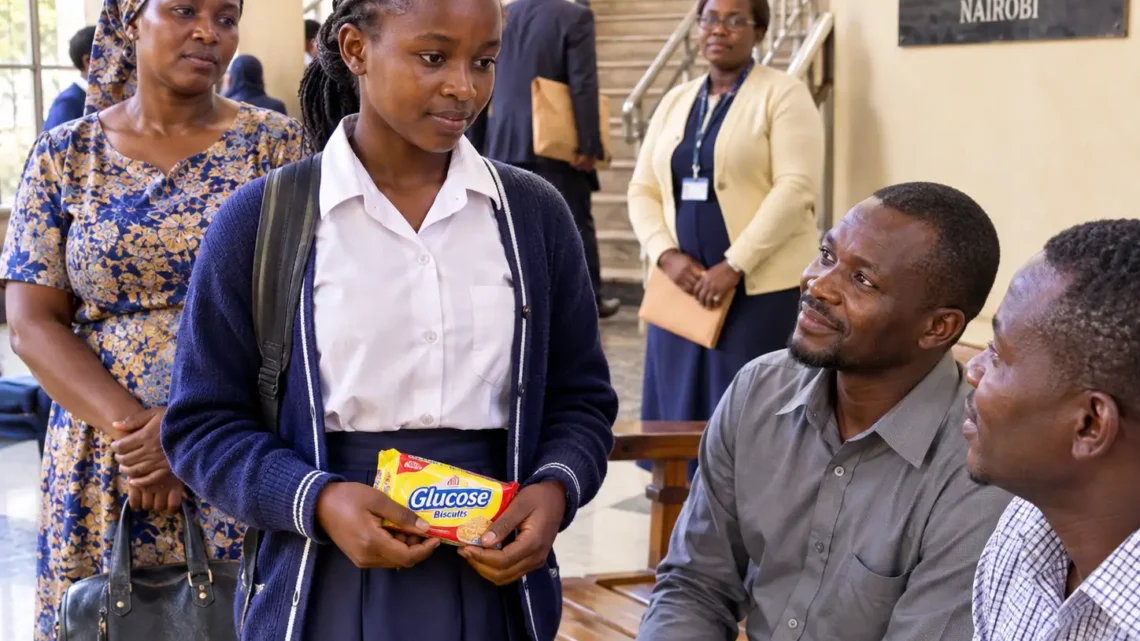
Mrs Achieng, the children’s officer, met them by the stairs. She wore a cream cardigan and low shoes, and she pressed a packet of Glucose biscuits into Wanjiru’s hand as though it were a document.
You will not see your father, she said. There is a screen. You only talk to the magistrate and the lawyers. Nobody will shout.
The waiting room had a faded poster of a giraffe and a stuffed lion missing one eye. Wanjiru sat holding the biscuits and did not open them. Through the wall she could hear a man’s voice, low and steady, and she knew without being told that it was him. She had heard that voice every morning of her life.
Madam Chebet, the magistrate, was smaller than she expected. She spoke slowly, with a calm that Wanjiru did not trust at first. The screen was a grey panel on wheels. Under its bottom edge, if she tilted her head, she could see a pair of black shoes with a glued sole.
The prosecutor asked her to say what she had seen. She said the eight words. They came out quieter than in the shower, and then the rest followed: the doorway, the belt, the sound Baraka made, which she did not describe because she could not.
The defence lawyer, Mr Mwangi, stood up. He was gentle, which was worse.
You are a brave girl, he said. Has your father ever hit you?
Yes.
More than he hit your brother?
Yes.
You are angry with him, then.
The room waited. Wanjiru thought about the water stain, and her mother’s hands on the handbag, and the three hundred shillings.
Yes, she said. I am angry. I am also not lying.
Madam Chebet wrote something down. Mr Mwangi nodded slowly, as if he had expected that answer and respected it anyway.
Who wakes you for school in the morning?
My father.
At what time?
Five.
What does he do at five?
She had not meant to answer this one. It came out of her like a hiccup.
He irons my uniform. He has done it since I was nine, because Mama leaves for the market at four. Her throat tightened. He leaves the tea on the stove. Two sugars. He does not ask me to thank him.
Under the screen, the black shoes did not move.
No further questions, said Mr Mwangi, and sat down, and she could not tell whether he had won something or lost it.
Madam Chebet thanked her. The case would be mentioned again in three weeks. The court would consider what was best for the children, which might mean a fine, or a counselling order, or a conviction with a sentence. Nobody could say yet. Wanjiru was free to go.
She walked out into the corridor with her legs not quite hers. Njeri was waiting by the wall, mouth pressed flat, eyes red. She did not hug her daughter. She did not say well done. She said Come, let us go home, and picked up her bag.
At the top of the stairs, they passed him.
Kamau was on a bench with his brother, in a shirt that had been ironed, Wanjiru noticed, by his own hand. He had no handcuffs on. He looked smaller than he did in the doorway of the flat. He looked at her, and she braced for anger, for the look she knew, the one that came before the belt.
It did not come.
Did you eat? he asked.
The packet of Glucose biscuits was still sealed in her hand. The stairs went down behind her toward the street, the matatus, the fifth of the month, the house that would or would not still have a father in it.
She opened her mouth. Whatever she said next, she would have to live with in a flat with one bedroom, one stove, and one water stain shaped like a country she had never visited.
She had told the truth, and now she had to live in the house it had cost.