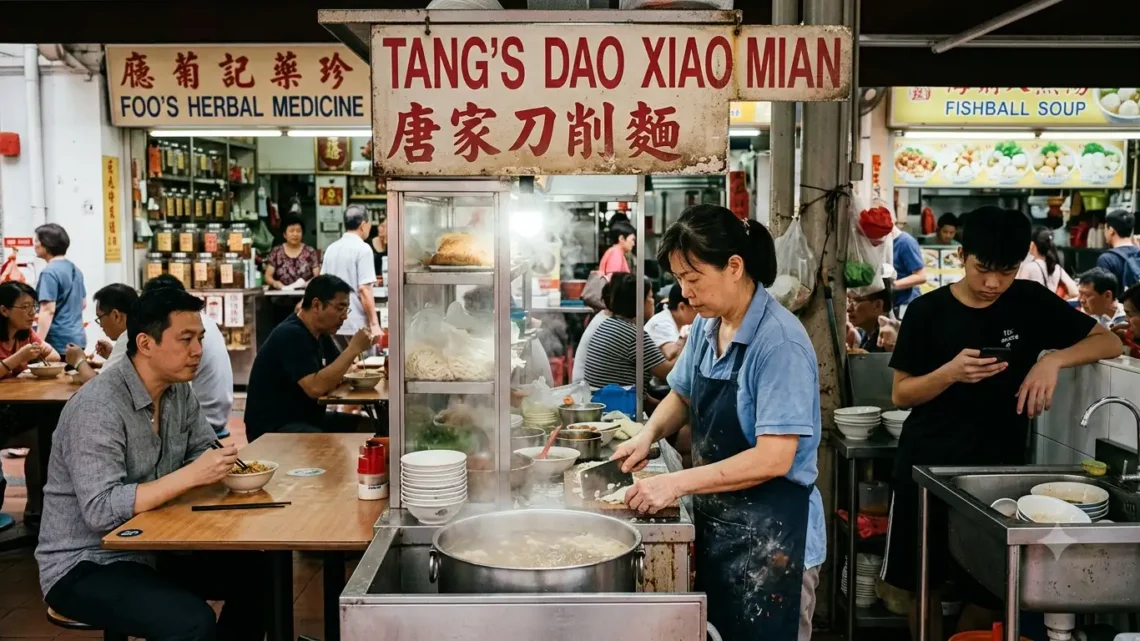
The Noodle Stall That Almost Got a Michelin Star
The knife hit the cutting board four hundred times before Mei-Lin Tang allowed herself to look at the clock above the noodle stall.
Six minutes, she said to no one, wiping her palms on her apron, which still smelled of last night’s chilli oil no matter how many times she washed it.
Trending Now!!:
The stall sat on Smith Street in Singapore’s Chinatown, wedged between a traditional medicine shop and a stall selling fishball soup, its red signage faded from two decades of monsoon seasons.
Tang’s Dao Xiao Mian the sign read, hand-painted by her father back when his hands didn’t shake. Mei-Lin had inherited the recipe, the rent, and the shaking, though hers came from anxiety rather than age.
Six minutes until the Michelin inspector’s reservation. Or so the rumor went, whispered by Auntie Foo from the medicine shop who claimed her nephew worked at the inspection office, a claim as unverifiable as it was electrifying through the entire hawker center.
You’re going to crack the dough wrong if your hands keep shaking like that, said Kenny, her dishwasher, sixteen years old and unbothered by anything except his phone battery dying.




I am not shaking.
You’re shaking.
She was shaking. The knife-cut noodles, dao xiao mian, required a blade drawn directly across the dough block in long ribbons that fell straight into boiling broth, no rolling pin, no machine, just wrist and blade and forty years of muscle memory passed down from a man who’d fled Guangzhou with nothing but this exact skill in his hands.
Her father used to say the noodles tasted of fear if your hands weren’t steady. She’d laughed at that once. She wasn’t laughing now.
The broth had simmered since four that morning: pork bones, dried flounder, a knuckle of ginger, white pepper that bit the back of the throat on the exhale. It was the kind of broth food bloggers called umami-rich, though her father only ever called it honest. The kind of soup that didn’t lie about what went into it.
A man in a gray linen shirt sat down at table six. No notebook, no camera, nothing to mark him as anything other than a man who wanted lunch. But Mei-Lin had spent three years watching customers and she knew the difference between hunger and observation.
This man’s eyes moved across the stall the way you’d read a room before testifying in it.
One bowl, dao xiao mian, dry style, he said, not looking up from his phone.
She cut the noodles by hand, the way she always had, though her wrist ached from the strain of being watched. The blade caught the light from the single bulb hanging above her station, sliced through dough that her father had once described as needing to feel like a baby’s earlobe, soft but with give.
The ribbons fell into the pot in a rhythm that, on a good day, felt like music. Today it felt like a metronome counting down to her own execution.
She plated it the way she always did: noodles tossed in lard, dark soy, a tangle of minced pork, choy sum blanched bright green, a scattering of fried shallots her father used to burn on purpose because he said burnt shallots tasted of memory.
The man ate in silence. Mei-Lin pretended to wipe down a counter that was already clean.
Your father ran this stall before you, the man said. Not a question.
Forty-one years. He passed it to me three years ago.
I remember him. I used to come here as a boy, before I moved to KL. He set his chopsticks down, parallel, the way her father had taught every customer without ever saying a word about it, just by example. He once told me a story about this broth. Said his mother made it for him the week before he left Guangzhou, and he memorized the taste because he didn’t know if he’d ever taste home again.
Mei-Lin’s hands stopped moving.
He told you that?
He told everyone that, eventually. Different version each time. But the broth was always the same. The man smiled, finally looking up. I’m not who your aunt thinks I am. I work in shipping, container logistics, nothing exciting. I just wanted to see if the noodles were still cut the same way.
The disappointment should have hit harder than it did.
No Michelin inspector, no validation stamped in a red guidebook that tourists would flash on Instagram, no surge of customers searching best hawker food Singapore at midnight because some anonymous critic had blessed this particular bowl. Just a man who used to be a boy, eating lunch where his memories lived.
The broth’s the same, she said. I haven’t changed it.
I can tell. He paid in cash, folded neatly, the way an older generation still did even in a city racing toward cashless everything. Your father used to undercharge everyone. I see you do too.
Some habits you keep even when they don’t make sense.
That’s not a flaw, he said, standing, smoothing his shirt. That’s an inheritance.
After he left, Kenny leaned against the sink, drying a bowl with the particular slowness of a teenager who’d rather be doing anything else. So no Michelin guy?
No Michelin guy.
Auntie Foo’s nephew is full of it, then.
Probably.
But Mei-Lin found herself smiling anyway, slicing the next block of dough with hands that, for the first time all morning, didn’t shake. The broth simmered behind her, honest as her father had always insisted it be, asking nothing of anyone except to be tasted exactly as it was.
She thought of him then, not as the man whose hands trembled toward the end, but as the boy who’d once memorized a flavor because he was terrified of forgetting where he came from.
She ladled a small bowl for herself, the broth catching steam in the humid afternoon air, and ate standing up at her own stall, the way he used to, the way she imagined she’d keep doing until her own hands started shaking for reasons other than fear.
The lunch rush came twenty minutes later, no inspector, no review, no viral foodie post promising the world’s best noodle soup Singapore had to offer.
Just regulars, a queue forming past the medicine shop, the scrape of stools, the particular clatter of a hawker center at full noise. Ordinary. Honest. Exactly as it should be.