The Side Hustle That Started Causing Problems at Home
You said the last Saturday was the last Saturday, Ola said, without looking up from the iron.
I was on one knee in the hallway of our flat in Retkinia, on the west side of Łódź, stuffing my Bosch drill into a gym bag that had never been to a gym. It was 7:40.
Trending Now!!:
The kettle had just clicked off, the whole place smelled of warm cotton, and our daughter Zuzia was eating cornflakes in one sock.
It’s a small one, I said. Two hours.
You said that about the bed in Widzew.



The bed in Widzew took five hours because the man had lost a bag of screws and wanted to talk about his divorce. I kissed the top of Zuzia’s head, told Ola I’d bring bread, and left before the iron went quiet.
I should explain how a courier depot dispatcher became a man who builds other people’s wardrobes. Two years ago our monthly mortgage payment climbed from 1,900 złoty (about $475) to just over 3,000 (about $750). Everything else went up with it: the gas, the school lunches, even the cheap washing powder at Biedronka.
We started paying for normal life with the credit card. Then we took a joint loan to pay off the card, and then, like idiots, we used the card again. By the spring before last we owed 26,000 złoty (about $6,500) on top of the flat.
Ola works at a pharmacy, on her feet all day, smiling at people who shout about prescriptions. She couldn’t take more hours. I finished at four.
I put an ad on OLX with a blurry photo of a KALLAX shelf I’d built for Zuzia. “Furniture assembly, fast and careful.” The first job paid 120 złoty (about $30). I came home, laid the notes on the kitchen table, and Ola looked at them as if I’d carried in a live fish.
Look at you, she said. She was smiling.
We made a rule that night. I’d do it until the debt was gone, and not one week longer. She wrote the number on a yellow sticky note and put it on the fridge, under a magnet from Kołobrzeg. Every Sunday she crossed it out and wrote the new one.
At first it was two evenings a week. Soon it was four, plus Saturdays. I learned that people in the new blocks near Manufaktura tip better than you’d expect, and that nobody who orders a three-door wardrobe has measured the ceiling.
I also learned to eat in the car. A Żabka hot dog at six, a Prince Polo wafer at nine. I’d get home after Zuzia was asleep and find my dinner under an upside-down plate.
The problems at home didn’t arrive with any noise. I missed a parents’ evening. I fell asleep while Ola was telling me about her mother’s biopsy results, and woke up when she switched off the lamp. The results were fine, but I didn’t find that out until the next afternoon.
On the ninth of September, on the number 80 shelf unit of my life or somewhere near it, I made the last payment. I was sitting on the floor of a stranger’s living room, surrounded by cardboard. I tapped in the BLIK code, the loan balance showed zero, and I stared at it until the screen went dark.
I had imagined this moment for eighteen months. I was going to buy flowers. I was going to walk in, peel the sticky note off the fridge and eat it to make Zuzia laugh.
The client came in just then. Mrs. Wiśniewska was a widow of about seventy who lived off Piotrkowska Street, in an old building with a dark gate and stairs that smelled of coal and floor polish. She put a glass of tea beside me and looked at the finished shelves.
My husband would have taken a week, she said. You have good hands. Thank you, really.
I drove home without flowers. The sticky note said 1,150 (about $288). I looked at it, washed my hands, and asked what was for dinner.
I told myself I’d announce it on Sunday. On Sunday Ola was upset because I’d forgotten to buy milk, and it didn’t feel like the right time. The next Sunday she didn’t update the note at all. I decided she was too busy, and I was relieved.
After that I kept taking jobs. The money went into a separate savings account, and I called it the holiday fund in my head. I’d like you to believe that was the reason.
Here’s the reason. When I ring a doorbell with my tool bag, someone is happy to see me. They’ve been sitting among forty boards and a paper bag of little metal pieces, close to tears, and then I show up. I fix it, they clap or make coffee, they say I’m a lifesaver, and I leave before they learn a single other thing about me.
At home nobody claps. At home I’m the man who left wet towels on the bed and doesn’t know which day is swimming. Lying to my wife was easier than walking back into a place where I’d become bad at things.
Some Saturdays there wasn’t even a job. I said there was. I parked behind a petrol station on the far side of Łódź, pushed the seat back and watched videos of people restoring rusty knives. Once I slept for two hours with the heater running and woke up happier than I’d been in weeks. Call it burnout if you like. I called it Saturday.
This morning’s job was real: a chest of drawers for a young couple who argued in whispers about whose idea the colour was. I was done by half past nine. On the last drawer, my phone buzzed.
It was a photo from Ola. Zuzia stood in the hallway in a white blouse, the one from the iron, with a paper crown on her head. Under it: “11:00. She keeps asking.”
Her first school performance. She had one line, as the Second Star. I’d heard it through the bathroom door all week, and I had still let the date slide right out of my head when I accepted the booking.
I made it with six minutes to spare. The school hall smelled of radiators and wet jackets. Ola had saved me a chair by putting her bag on it, and she moved the bag without a word.
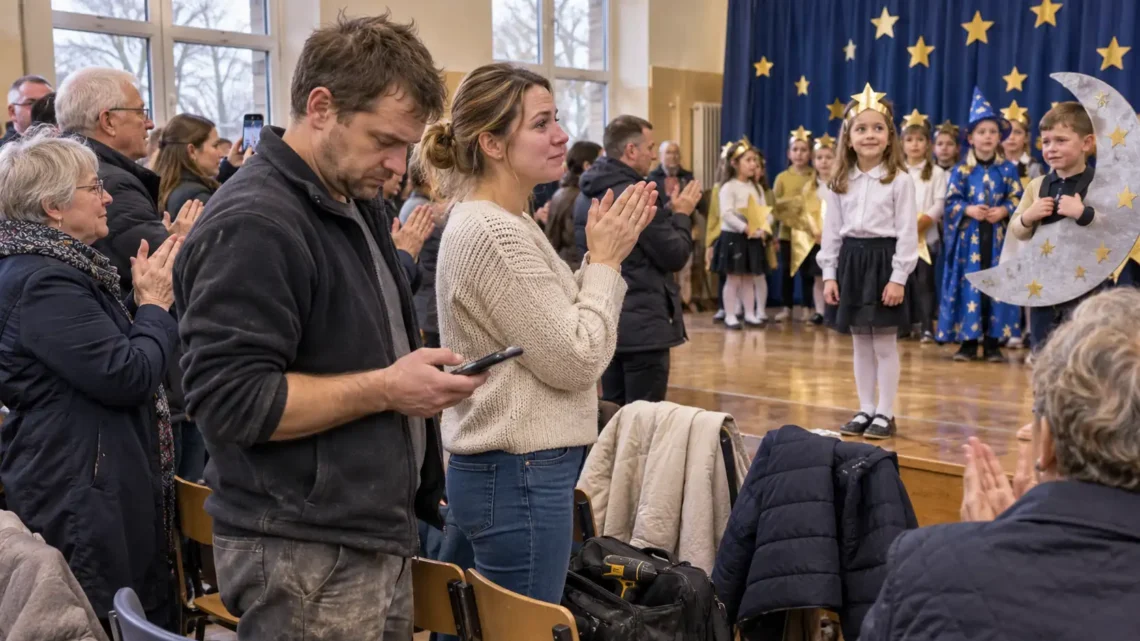
Zuzia said her line too fast, found me in the third row and said it again, slower, just for me. People laughed kindly. My throat closed up, and I pretended to check the zoom on my camera.
Then my phone lit up on my knee. A regular client, a dentist in a new building near the centre. “Emergency. Full PAX wardrobe, today at 12:00. 700 zł if you can come.” That’s about $175, for an afternoon.
Ola read it. She didn’t even pretend she hadn’t.
Go on, she whispered. We need it, don’t we?
It’s good money.
For the loan.
On the stage, a boy dressed as the moon was crying because his elastic had snapped. Ola watched him. Her hands lay very still in her lap.
It was a joint loan, Michał, she said. The bank sent me a message too.
I couldn’t feel my fingers. I counted backwards. September, October, nearly all of November. Eleven Saturdays.
Why didn’t you say anything?
I bought a cake that night. She was still facing the stage. Chocolate, from the place by the tram stop. You came home and asked what was for dinner.
I remembered a white box in the fridge. I remembered thinking it was for someone at her work.
I thought you’d tell me the next day, she said. Then I thought, the next week. After a while I just wanted to see how long you could look at me and do it.
I wanted to be angry. She’d watched me lie for two and a half months, kissed me goodbye at the door, asked how the jobs went. I wanted to say that was cruel too. I opened my mouth and could hear exactly how it would sound coming from me.
Is there someone? she asked.
No. God, no. It’s wardrobes.
She finally turned. Her eyes were red and tired, and she studied me for a long time.
I think I could’ve understood someone, she said. You’d rather build furniture for strangers than sit in our kitchen.
The children lined up to bow. Everyone around us stood and clapped, phones in the air. We stood too. Zuzia was searching for us between the heads, her crown slipping over one ear.
The dentist wrote again. “Yes or no? Need to know now.”
I had the reply box open. Ola kept clapping, eyes straight ahead, and I knew she could see my thumb. In my head I had both messages ready, and one of them began with “just this last one.”
I have never once failed to build something that came with instructions.