The Strangest Thing I Found in My Government Record Was a Husband I Never Married
You cannot get your own money back until the computer says you are alive.
That was what the clerk told me at 10:18 on a Thursday morning, while pushing my application back across a scratched wooden desk.
Trending Now!!:
I looked at the paper.
My name was spelled correctly. My date of birth was correct. My address was correct.
Everything looked fine.
Except for one tiny box.



Under marital status, the system had me listed as married.
I was not married.
I was not even dating anyone.
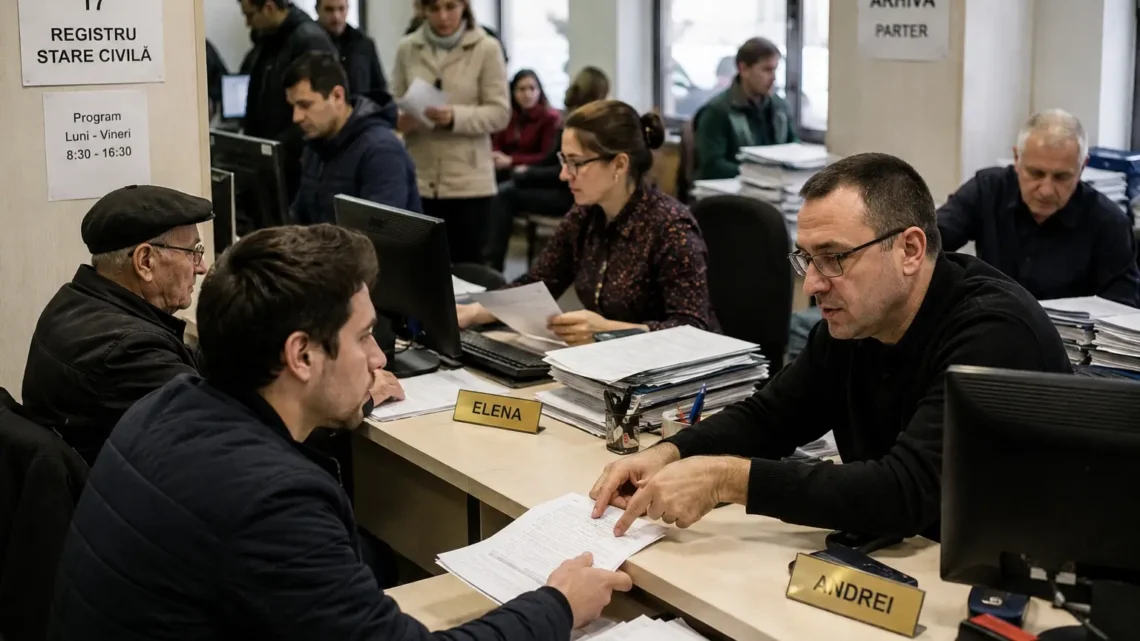
I had gone to the municipal office in Bucharest because I needed a simple certificate for a bank application. I had expected to be there for twenty minutes, maybe thirty if the queue was bad.
By 10:18, I had already been there for almost three hours.
The clerk, Andrei, tapped the screen with one finger.
According to the system, you are married.
According to me, I am not.
He shrugged.
Then the system is wrong.
I waited for him to laugh.
He did not.
Outside the office, people smoked near the entrance even though there was a sign asking them not to. A delivery scooter was parked half on the pavement. Across the road, buses moved along Bulevardul Unirii, carrying people who had somewhere else to be.
I had somewhere else to be too.
That was becoming the problem.
I had taken the morning off work because my bank needed the certificate before the end of the week. I was applying for a small mortgage, nothing dramatic. After years of renting a two-room apartment in Bucharest and watching the price rise every time my landlord renewed the contract, I had finally decided to try buying a place.
The bank had asked for documents.
The government had given me a husband.
Neither of them was particularly helpful.
Andrei picked up my application again.
You need to go to civil records.
Where is that?
He pointed toward the corridor.
Second floor.
Do I need another number?
He looked at me.
Of course.
I walked upstairs.
The second floor smelled like old paper, floor cleaner and coffee that had been sitting too long in a plastic cup.
A woman behind a glass window was eating a cheese sandwich.
I showed her my paper.
She read it.
Then she looked at me.
Who is your husband?
I almost laughed.
I would like to know.
She did not smile.
You need the marriage record.
There is no marriage record.
Then you need a certificate saying there is no marriage record.
Where do I get that?
She pointed down the corridor.
Room 17.
I looked at the number above the door.
At least the building had started giving me instructions in a language I understood.
Room 17 was closed.
A handwritten note on the door said the officer would return at 11:30.
It was 10:47.
I sat on a bench beside an old man holding a folder tied with blue string.
He glanced at my papers.
Marriage problem?
I nodded.
Not exactly.
He smiled.
They always say that.
His name was Mihai. He was seventy-two and had come to correct the spelling of his mother’s name on his pension documents.
He had been trying for four months.
They put an extra letter in it, he told me.
One letter?
One letter.
He laughed.
One letter has destroyed my entire life.
I laughed too.
It felt good to laugh.
We sat there for another twenty minutes.
People came and went.
A young woman with a baby argued quietly with someone on the phone. A man in a suit kept refreshing an email on his phone. Two employees walked past carrying cups from a nearby cafe, talking about a football match.
At 11:31, Room 17 opened.
A woman named Elena appeared.
She looked at the queue.
The queue looked back at her.
She sighed.
One at a time, please.
Nobody moved.
She pointed at Mihai.
He stood.
I expected to wait another hour.
Instead, he came out after seven minutes.
He looked at me.
She says I need a different document.
Of course she does.
He smiled.
Good luck.
Then he disappeared down the stairs.
My turn came.
I handed Elena my papers.
She looked at the computer.
Then at me.
Then back at the computer.
When did you get married?
I did not.
The system says you did.
I know.
She clicked through several screens.
It says 2019.
I was living in London in 2019.
She looked up.
Were you married in London?
No.
Romania?
No.
Anywhere?
No.
She frowned.
Are you sure?
That question annoyed me more than it should have.
Yes.
She typed something.
Then she stopped.
There is another person with your name.
My stomach tightened.
Another person?
Same name. Same date of birth.
I stared at her.
How is that possible?
She shrugged.
People have the same names.
But the same date of birth?
She shrugged again.
It happens.
It did not feel like something that should happen.
She printed a page.
At the top was my name.
Below it was a date.
And underneath that, the name of a man.
Radu Popescu.
My heart started beating faster.
I had never heard of him.
Elena looked at the screen.
This person registered a marriage in 2019.
With who?
She clicked.
Then she frowned.
Another woman.
I leaned forward.
So he is married to somebody else?
According to this record.
I stared at the paper.
There it was.
My full name.
My date of birth.
A marriage I had never attended.
A husband I had never met.
For a few seconds, the whole thing was almost funny.
Then it stopped being funny.
Because the bank was waiting for my certificate.
Because government records followed people.
Because one wrong entry could make a person spend weeks proving that they were themselves.
Elena printed another document.
You need to go to the archive.
I closed my eyes.
Where is the archive?
She pointed downstairs.
Basement.
I looked at the ceiling.
Of course.
The archive was colder than the rest of the building.
A man named Victor sat behind another desk surrounded by folders.
He listened to my story.
Then he rubbed his forehead.
This happens.
How often?
He smiled.
Often enough.
He searched through a database.
Then he searched again.
Then he asked for my identity card.
He checked it three times.
Finally, he found the record.
The mistake had been made years earlier when a clerk entered the wrong identification number into a marriage record.
My name had become attached to another man’s file.
Nobody had noticed.
Nobody had needed to notice.
Until I needed a certificate.
Victor printed a correction form.
Fill this out.
I took the pen.
How long will it take?
He paused.
Normally? Two weeks.
I stared at him.
I need the certificate tomorrow.
He looked genuinely sorry.
Tomorrow is difficult.
I have a bank appointment.
I understand.
If I miss it, I lose the apartment.
He nodded.
For the first time that morning, someone did not tell me to come back later.
He looked at the form again.
Then he picked up the phone.
He called someone upstairs.
I could only hear his side.
Yes. I have the case.
Pause.
No, it is clearly a data entry error.
Another pause.
Yes, today.
He hung up.
Go back to Room 17.
I went upstairs.
By then it was almost two o’clock.
My boss had sent me a message asking if everything was okay.
I typed that I was dealing with government paperwork.
She replied with a thumbs-up emoji.
Then, five minutes later, she sent another message.
Government paperwork is never just paperwork.
I smiled.
She was right.
In Room 17, Elena took my form.
She checked it.
Then she checked my identity card.
Then she called Victor.
They spoke quietly.
Twenty minutes later, she printed a new certificate.
I looked at it.
Single.
The word sat there in black ink like it had been personally rescued from a burning building.
I almost wanted to frame it.
Elena handed it to me.
Check everything before you leave.
I read the page twice.
My name.
My date of birth.
My address.
Single.
Correct.
I thanked her.
She smiled.
Next time, try not to accidentally get married.
I laughed.
I will do my best.
When I stepped outside, Bucharest was loud again.
Traffic crawled along the boulevard. Someone was selling pretzels near the bus stop. A man was arguing with a parking officer. My phone showed fourteen missed messages and three emails.
I stood on the pavement and looked at the certificate one more time.
For three hours, I had been angry at the people behind the desks.
Then I realized something.
Most of them had been trying to fix a mistake they had not made.
Andrei had not created the wrong record.
Elena had not entered it.
Victor had not caused it.
Somewhere, years earlier, somebody had typed one wrong number.
That was all.
One number.
A tiny mistake sitting quietly inside a government database until one ordinary person needed a piece of paper.
I walked toward the bus stop and called the bank.
I have the certificate, I said.
The woman on the phone sounded relieved.
Perfect. Bring it tomorrow.
I looked at the document in my hand.
Tomorrow works.
Then I put it carefully inside my bag.
For the rest of the afternoon, I kept thinking about the strange fact that I had spent half a day proving something I had always considered obvious.
I was unmarried.
I knew it.
My family knew it.
My friends knew it.
The people I had dated knew it.
Yet none of that mattered when a computer somewhere said otherwise.
By the time my bus arrived, I was laughing again.
I had gone to the government office to get one small certificate, and I came home with proof that I was not married to a complete stranger.
In the end, the most important document I owned was the one proving I was still myself.