We All Took Turns Feeding This Dog, Until the Real Owner Finally Found Him
The dog climbed into the taxi while I was still arguing with the driver about the fare.
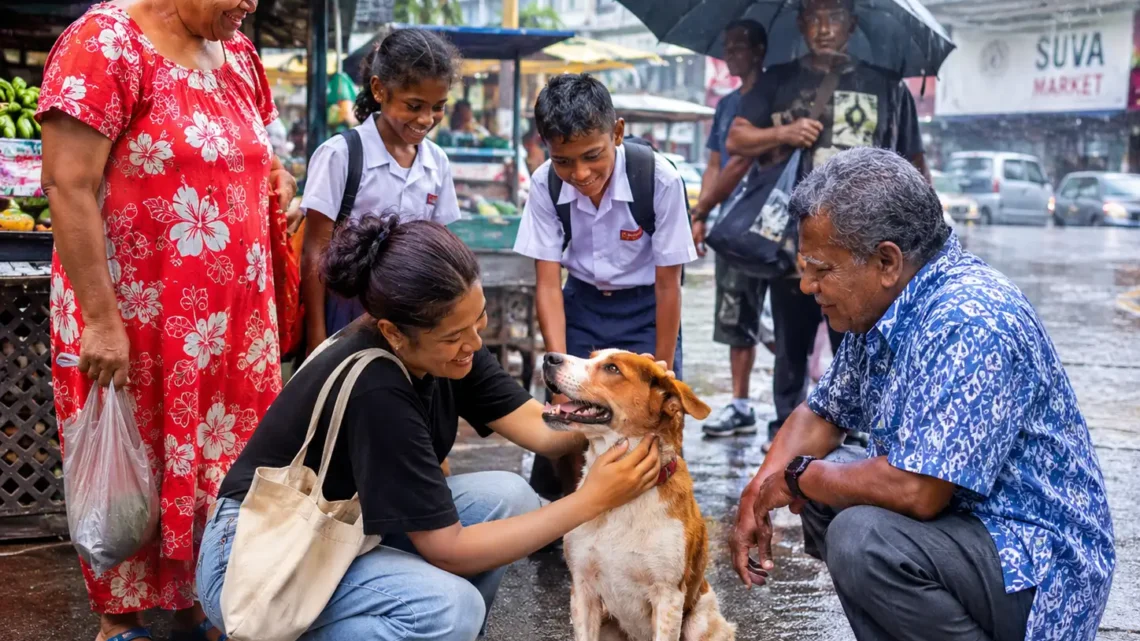
It happened on a wet Thursday morning in Suva, when the rain had turned the road outside the Suva Municipal Market into a shining mess of buses, umbrellas, puddles and people carrying plastic bags over their heads.
Trending Now!!:
I had one foot inside the taxi and one outside when the dog pushed past my leg, shook himself once, and settled on the floor between the front and back seats.
The driver stared at him.
I stared at him.
The dog looked at both of us as if we were the ones behaving strangely.


He is not my dog, I said.
He seems to think he is, the driver replied.
The dog was medium-sized, brown and white, with one ear that stood up and another that folded over. His fur was wet and smelled faintly of rain, mud and whatever he had found behind the market. Around his neck was a faded red collar, but there was no tag.
The driver sighed.
If he pays his fare, he can stay.
That was how Bula came into my life.
At the time, I was twenty-nine and living in a small upstairs flat near Toorak. I worked in an office on Victoria Parade, spent too much money on takeaway coffee, and had recently started telling people I was saving money even though my bank balance suggested otherwise.
My mornings were usually predictable. I would buy a bun or roti from a bakery, check my messages while walking, and catch a bus if I was early enough to get one that was not already packed.
That Thursday was different because of the rain.
The taxi driver dropped me near my office, and Bula followed me out.
No, I told him.
He followed.
Seriously, no.
He followed.
I crossed the road.
He crossed the road.
I walked into a small shop and pretended to look at phone chargers. When I came out, he was sitting beside the doorway.
He had waited.
I crouched down.
You cannot follow me to work.
He wagged his tail once.
I pointed at him.
That is not an answer.
He wagged it again.
I eventually walked into the office alone.
For the next seven hours, I tried to forget him.
I failed.
At lunchtime, I went downstairs and found him sleeping beneath the awning across the road. Someone had given him half a sausage roll. A security guard had put a cardboard box near him to keep him out of the rain.
The dog had apparently acquired a small staff.
By Friday, everyone knew him.
The security guard called him Bula because he greeted everybody. A woman who sold coconut water near the market gave him scraps. A bus driver sometimes tossed him a piece of chicken. Two schoolchildren scratched his ears every afternoon.
Nobody knew where he lived.
That became the strange thing about him.
Everyone fed him.
Nobody owned him.
I started carrying dog biscuits in my handbag.
This was not part of my financial plan.
The first time I bought them, I stood in a supermarket near Cumming Street holding two packets and calculating the price in my head. I had been trying to cut down on unnecessary spending because my rent had gone up and my electricity bill had arrived at almost exactly the wrong time.
I bought the biscuits anyway.
When I returned to the office, Bula was lying under a parked car.
He saw the packet.
His entire body changed.
His tail began hitting the ground.
Do not look at me like that, I said.
He looked.
I gave him two biscuits.
He ate them carefully, then sat down and waited for another.
That became our routine.
I never officially adopted him.
That is what I told myself.
I just happened to know what time he usually appeared.
I just happened to notice when he limped.
I just happened to keep biscuits in my drawer.
I just happened to ask the security guard if he had seen Bula when the dog disappeared for two days.
The truth was that I had become one of his people.
There were others.
Mere, the woman selling fruit near the market, was the first person to notice that Bula did not like thunder. Whenever rain became heavy, he would move closer to the covered stalls and sit with his back against a wall.
Jone, the security guard, said Bula had been around for at least a year.
He came before you, Jone told me.
I know.
He will leave after you.
I know.
I did not like the way he said it.
One Monday morning, Bula was missing.
I asked Jone.
Nothing.
I asked Mere.
Nothing.
I walked around the market looking under tables and beside parked cars. I checked the places where he normally slept.
Nothing.
By lunchtime, I had sent messages to two people in the office.
Anyone seen Bula?
Nobody had.
I felt ridiculous.
He was a dog.
People lost dogs every day. People found dogs every day. The world did not stop because one brown-and-white dog had decided not to sleep beneath a market awning.
Still, I kept looking.
At about four in the afternoon, I found him behind a row of shops near Harris Road.
He was lying on his side.
There was something wrong with his back leg.
I called Jone.
We got him to a small veterinary clinic.
The vet said he had likely been hit by a car.
The words were calm.
My hands were not.
The bill was more than I had expected.
I stared at the estimate.
Jone stood beside me.
We can all put something in, he said.
That was how we discovered that Bula belonged to more people than we realised.
Mere gave money from her fruit sales.
The security guard gave part of his weekly pay.
A bus driver contributed.
The schoolchildren returned the next day with coins they had collected from their parents.
I gave what I could.
Nobody asked who owned the dog.
They only asked how much was still needed.
Bula survived.
For several weeks, he stayed near the market while his leg healed. People took turns checking on him. Someone brought an old blanket. Someone else brought a bowl.
I started taking him for short walks after work.
That was when I began noticing things about the city differently.
I noticed the smell of fried cassava near the market.
I noticed how the rain sounded against the roofs on Gordon Street.
I noticed people who normally rushed past each other stopping to greet Bula.
A man who had never spoken to me before would say, How is our boy?
A woman would bend down and ask, Has he eaten?
Children would argue over who got to hold his leash.
It was strange.
Nobody had planned a community.
A dog had simply wandered into one.
Then, one Saturday morning, a man walked into the market and asked for him.
His name was Ratu.
He was in his late fifties, wearing work trousers, rubber sandals and a faded blue shirt. He had come from outside Suva and carried an old photograph folded inside a plastic bag.
The photograph showed Bula.
Not the same Bula we knew.
A younger Bula.
Thicker.
Cleaner.
His ears were exactly the same.
The red collar was the same too.
Ratu looked at the dog for a long time before touching his head.
Bula stood very still.
Then he licked the man’s hand.
Nobody spoke.
Ratu started crying.
He told us the dog’s real name was Tama.
Tama had disappeared almost two years earlier after a gate was left open during a storm.
Ratu had searched for him for months.
He had put notices around nearby areas. He had asked people at bus stations. Eventually, his family assumed the dog was dead.
He had only come to Suva that weekend because his sister was ill.
Someone had told him there was a brown-and-white dog around the market that looked familiar.
He had not believed them.
Until he saw the collar.
I watched Ratu kneel beside the dog.
Come home, Tama, he said.
The dog wagged his tail.
Then he looked at Mere.
He looked at Jone.
He looked at me.
I do not know why that moment felt like betrayal.
Nobody had promised me anything.
Nobody had promised any of us anything.
Still, I felt it.
For almost two years, we had believed Bula was nobody’s dog.
We had built a little life around that belief.
Now someone had arrived with a photograph and a history we knew nothing about.
Ratu said he wanted to take him home.
Most people agreed immediately.
I did not.
He has a life here, I said.
The sentence came out before I could stop it.
Ratu looked at me.
He had a life before here too.
That ended the argument.
We stood there in the rain.
The dog sat between us.
I wanted to tell Ratu about the biscuits. About the thunder. About the cardboard box. About how Bula slept beside the market entrance every Thursday. About how he had become the reason people who barely knew each other stopped to talk.
Instead, I asked where he lived.
He told me.
It was not far.
He promised to send photographs.
He did.
Bula left with him that afternoon.
For three days, the market felt strangely empty.
I still carried biscuits in my bag.
On the fourth day, I stopped.
That evening, I received a message from Ratu.
There was a photograph of Bula lying on an old mat beside a wooden chair.
Underneath it, Ratu had written that Bula had spent the whole night sleeping beside his bed.
I stared at the photograph for a long time.
Then I noticed something.
Bula was wearing the same faded red collar.
The one we had never replaced because nobody wanted to make him look like someone else’s dog.
I saved the photograph.
Months later, I still sometimes see brown-and-white dogs near the market and slow down.
Once, I bought a packet of biscuits without thinking.
I carried it halfway home before remembering that Bula was not waiting for me anymore.
I almost threw the packet away.
Instead, I gave it to a different dog sitting beneath a shop awning.
The dog took one biscuit and looked at me.
For a second, I felt foolish.
Then its tail moved.
Sometimes loving something means admitting it was never yours to keep.