I Asked Her to Give Me a Reason to Stay, and Her Answer Broke Me
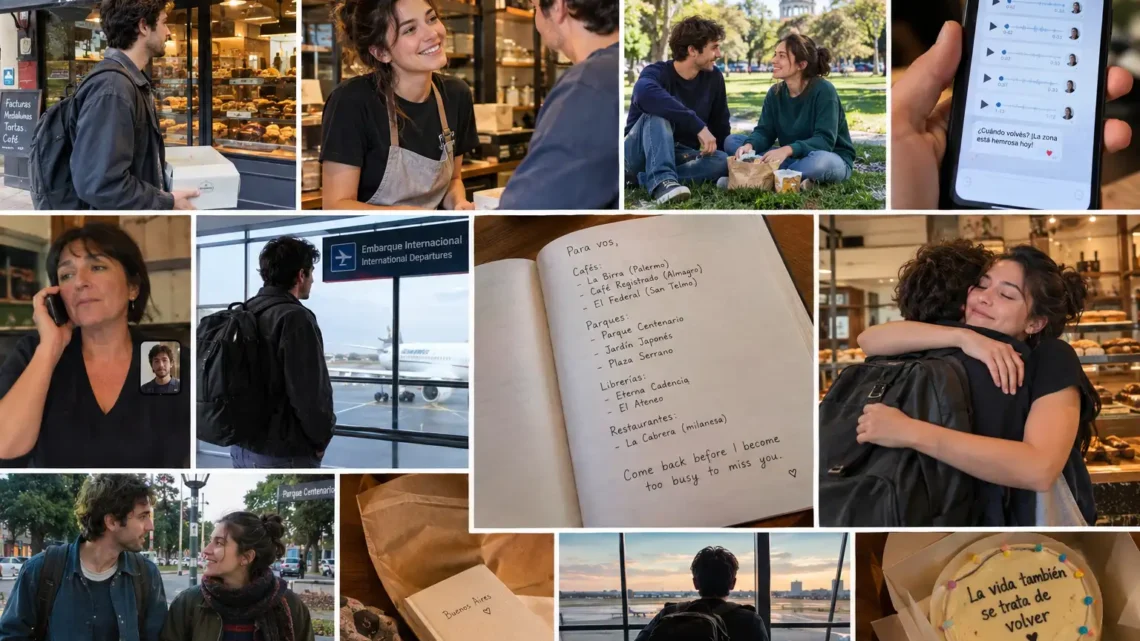
The first time I lied to Lucía, I was standing outside a bakery with a wedding cake in my hands.
She had just asked me the one question I had spent six months avoiding.
Trending Now!!:
Are you staying in Buenos Aires?
I looked at the cake, then at her, and said, I think so.
That was not the answer.
The truth was that I had already bought a plane ticket to Madrid for three weeks later.



I had not told anyone.
Not my mother, not my brother, not the two friends who kept sending me apartment listings in Palermo, and certainly not Lucía, who had somehow become part of my daily life without either of us deciding that she should.
It had started with a broken coffee machine.
I was renting a small apartment near Almagro, above a pharmacy that stayed open far too late. The apartment was fine in the way cheap apartments are fine when you spend most of your time outside them. The shower changed temperature whenever someone in the building flushed a toilet. The bedroom window looked directly at another wall. Every morning, I could hear the first buses moving along Avenida Rivadavia before my alarm.
I worked remotely for a European company, which sounded glamorous until the fourth video call of the day began with someone asking whether I had seen the spreadsheet.
Most days, I ate something quick and called it lunch.
Then I met Lucía.
She worked at a bakery on a corner near Parque Centenario. I had gone there because my coffee machine had died, and I had decided that buying coffee outside was cheaper than replacing it.
That logic lasted about two weeks.
The bakery became my place.
Lucía knew my order by the third visit. By the fifth, she knew I hated raisins. By the seventh, she stopped asking whether I wanted sugar.
You are becoming predictable, she told me one morning.
That sounds dangerous.
It is. Predictable people get charged for their habits.
She smiled when she said it.
I started staying longer.
Sometimes we talked for ten minutes. Sometimes thirty. Sometimes I worked from the small table near the window while she served customers, and we barely spoke at all.
There was no grand moment.
No music started playing.
Nobody spilled a drink.
There was simply a gradual change in the way the day felt when she was there.
One afternoon, rain trapped half the neighborhood inside the bakery. People stood near the door holding wet umbrellas, complaining about buses and checking their phones.
Lucía sat opposite me during her break.
Do you ever think about leaving? she asked.
Leaving Buenos Aires?
She nodded.
I should have told her then.
Instead I said, Sometimes.
She looked out at the rain.
I think about staying.
That sentence stayed with me longer than it should have.
Over the next few months, we became close enough that other people started assuming we were together.
The old man who sold newspapers near the bakery called us the married couple once.
Lucía nearly choked on her coffee.
We are not married, she said.
Not yet, the old man replied.
She laughed.
I pretended not to notice that I was smiling.
We did ordinary things together.
We walked through Parque Centenario after work. We shared empanadas when neither of us wanted to cook. She sent me voice notes complaining about customers who wanted oat milk after the kitchen had closed.
I sent her pictures of strange things I saw around the city.
A dog wearing tiny boots.
A man sleeping through an entire bus ride while holding a bouquet of flowers.
A pigeon sitting inside a parked car as if it had paid for the vehicle.
She started sending me things too.
A badly decorated birthday cake.
Her grandmother’s old radio.
A screenshot of a restaurant menu because she knew I was trying to learn how to cook.
None of it felt like a relationship.
That was the problem.
It felt better than one.
There were no rules to break.
Then one Sunday, my mother called from abroad and told me my father was getting worse.
Nothing dramatic happened during the call.
That almost made it harder.
She spoke about appointments. Medication. A chair that had been moved closer to the window because he liked seeing the street.
At the end she said, If you are coming, come soon.
I said I would.
After the call, I opened my laptop and searched flights.
Three weeks later, I booked one.
I told myself I was not leaving Buenos Aires forever.
I told myself I could come back.
I told myself that people left cities every day and returned when they were ready.
The story sounded reasonable until I had to look Lucía in the eyes.
The wedding cake came into the story because her cousin was getting married.
She had asked me two days earlier if I could help carry it from the bakery to a car.
I said yes.
That was how I ended up outside the bakery holding a cake worth more than my monthly grocery budget while Lucía asked whether I was staying.
I think so, I said.
She looked at me for a second too long.
You think so?
I have not decided everything.
She nodded.
She did not ask again.
That evening, she became quieter.
The next morning, she did not send a voice note.
That bothered me more than it should have.
I went to the bakery after work.
Lucía was stacking boxes.
Are you angry with me? I asked.
No.
You are doing the thing where you say no but mean yes.
She smiled without looking up.
Maybe I am tired.
I stood there.
Then I said, I am leaving.
The box in her hands stopped moving.
For how long?
I do not know.
Why did you not tell me?
I had no good answer.
Because I was scared, was the real answer.
Because saying it aloud would make it real.
Because I had begun to care about her, and caring about someone makes every decision more expensive.
Instead I said, My father is sick.
Her face changed immediately.
Oh.
That single word contained more kindness than I deserved.
She came around the counter.
When are you going?
I told her.
She nodded.
Then she hugged me.
It was not romantic.
That was what hurt.
She held me like someone holding a friend who had received bad news.
For the next two weeks, we became almost normal again.
Almost.
She helped me sell my desk.
I helped her move two boxes into her grandmother’s apartment.
We ate at a small place near Avenida Corrientes and argued about whether fries should be shared.
She said yes.
I said no.
She stole mine anyway.
On my last Friday, she gave me a paper bag.
Inside was a small notebook.
On the first page she had written my name.
Under it was a list of places she said I should visit if I came back.
There were cafés, parks, bookshops, and one restaurant she insisted had the best milanesa in Buenos Aires.
At the bottom she had written one sentence.
Come back before I become too busy to miss you.
I read it three times.
Is this a goodbye? I asked.
She shrugged.
It is a notebook.
I laughed.
She did too.
Then I asked the question I had been afraid to ask.
If I stayed, would you want me to?
She looked at me.
For once, she did not joke.
I would want you to stay because you wanted to stay.
I knew exactly what she meant.
She did not want to become the reason I abandoned my father.
She did not want to be the person I blamed later.
She did not want my love to arrive with a suitcase full of guilt.
The next morning, I went to Ezeiza Airport.
My flight was at noon.
At 9:14, my phone buzzed.
It was a voice note from Lucía.
I listened to it twice.
I forgot to tell you something. The notebook has a second page.
I opened it.
There was another sentence.
If you come back, do not come back for me. Come back because Buenos Aires still feels like yours.
I sat at the gate for a long time.
The screen changed from boarding soon to final call.
I could have missed the flight.
I could have called her.
I could have done the brave thing, the selfish thing, the sensible thing, or some mixture of all three.
Instead, I boarded.
Months later, I still have the notebook.
My father is doing better than we expected, although better is a word doctors use carefully.
I speak to Lucía sometimes.
Not every day.
Not enough to know what she had for lunch or whether the bakery had a difficult customer.
Enough to know she changed her hair.
Enough to know her grandmother is doing well.
Enough to know there is still a table near the bakery window where I once spent entire afternoons pretending to work.
People talk about financial freedom as if money is the only thing that buys freedom.
They forget that sometimes freedom means being able to leave without turning another person’s heart into a debt.
I do not know what Lucía and I are now.
I do not know whether we will ever become something more.
I only know that whenever someone asks whether I regret leaving Buenos Aires, I think about a paper notebook, a bakery near Parque Centenario, and a woman who loved me enough not to ask me to choose her.
Sometimes love is not the person who asks you to stay, but the person who lets you go without making you feel guilty for leaving.