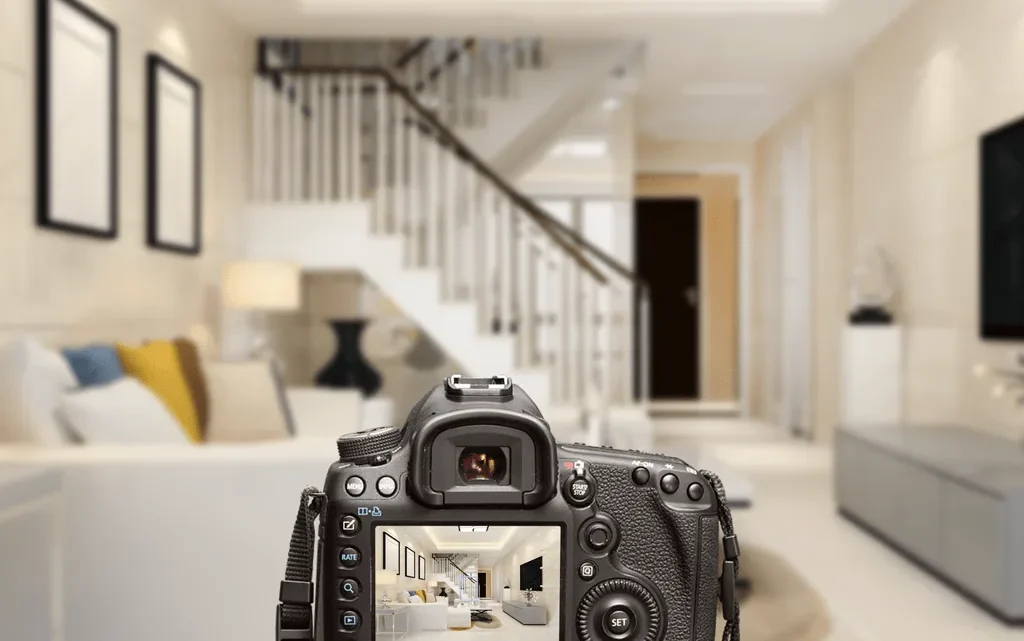
Real Estate Photography: The Side Business That Pays Per Shoot
The fee looks generous, but driving, editing, equipment, taxes and image rules decide whether a listing photographer builds a profitable sideline or simply stays busy.
A $225 listing shoot can look like an hour’s work with a generous fee attached.
Add the drive, the booking messages, the editing, the software, the gear that will eventually fail and the tax bill, and the same job can pay less than half that amount for three hours of effort.
Trending Now!!:
Real estate photography can still be a worthwhile side business. Standard U.S. residential shoots commonly bill about $150 to $350, with drone images, floor plans and video sold as extras.
Profit depends on pricing, drive time, editing speed, taxes and, above all, repeat clients who book often enough to fill the calendar.
The Economics Behind a Per-Shoot Fee
The appeal is clear. Each assignment has a defined scope, a short production cycle and a client with an immediate need.




A listing agent cannot market a home properly without images, and an active agent may need them again within weeks. Wedding work, by comparison, usually depends on a steady supply of new couples.
Online search explains the demand. In the National Association of Realtors (NAR) buyer and seller survey, 81% of buyers who used the internet rated photos a very useful website feature, ahead of every other feature. Floor plans scored 60%. In separate NAR staging research, 73% of buyers’ agents said listing photos were highly important to their clients.
Those findings show that buyers value images. They do not prove that hiring a professional will raise a home’s sale price or shorten its time on the market by a set amount. A photographer who promises either result is selling something the figures cannot support. Clear, accurate, consistent images delivered on schedule make a stronger pitch.
The wider trade also calls for caution. Employed photographers in the United States earn a median of $21.47 an hour, a Bureau of Labor Statistics figure that excludes the self-employed. About two-thirds of photographers work for themselves, and the bureau projects a 1% decline in overall photographer employment over its ten-year outlook.
It also expects self-employment to grow as more amateurs and hobbyists enter the field. A low barrier to entry brings competition with it.
Housing activity adds another variable. Listing photography follows homes coming to market, so a slow season or a high-rate environment can thin the calendar. U.S. existing-home sales recently fell to a seasonally adjusted annual pace of 3.75 million, a weak level by the standards of the past three decades.
Local new-listing volume matters more than the national figure, and it deserves a check before any money goes into equipment.
Rates, Packages and Add-On Fees
A standard residential photo package commonly sits between $150 and $350. Large homes, luxury listings and expensive metro areas can command more, while crowded or lower-priced markets may cluster near the bottom. Published rate surveys vary widely because they measure different home sizes, image counts and service bundles.
Typical add-on ranges include:
- Drone photography: about $75 to $300
- On-site twilight photography: about $150 to $300
- Listing video: about $125 to $600
- Two-dimensional floor plan: about $40 to $275
- Three-dimensional tour: about $125 to $350
- Virtual staging: about $16 to $75 per image
These are market reference points, not a rate card. The better test is to collect published packages from at least five local competitors and compare like with like: square footage, number of finished images, turnaround, travel radius, licensing terms and rescheduling fees.
A $175 package with a 15-mile travel limit and two-day delivery is a different product from a $250 package with next-morning delivery across an entire metro area.
Square-Footage Tiers Versus Flat Fees
A flat fee is easy to quote but punishes the photographer when a compact condominium and a sprawling house cost the client the same. Size tiers solve much of that problem.
A simple menu might have three bands, each with its own image count and price, followed by a custom quote for very large properties, acreage and luxury work.
Per-square-foot pricing tracks size closely, though a cluttered 1,800-square-foot home can take longer than a staged 2,800-square-foot one. Tiers with clear surcharges are usually easier for agents to understand. Travel beyond the service area, rush delivery, return visits and late cancellations should each have a stated price.
Cheap introductory rates deserve an end date and a written regular price. An agent who joins at $99 may regard $199 as a 101% increase, however reasonable the new figure is. A limited first-order credit against the normal rate protects the anchor price.
What One Shoot Really Pays
Consider a hypothetical $225 assignment. The photographer drives 30 miles round trip, delivers 30 images and outsources the editing. These cost assumptions are examples, not industry averages:
- Vehicle cost at 75 cents a mile: $22.50
- Editing at $1 per image: $30
- Reserve for software, insurance and equipment replacement: $20
- Payment processing at 3%: $6.75
Costs total $79.25, leaving $145.75 before tax.
Time tells the rest of the story. Allow 20 minutes for booking and administration, an hour for driving, an hour for setup and shooting and 40 minutes for file handling, quality checks and delivery. The job takes three hours, so the pre-tax return is about $48.58 an hour.
Federal self-employment tax comes next for U.S. operators. The IRS generally requires it once net earnings from self-employment reach $400, at a combined 15.3% rate for Social Security and Medicare, usually applied to 92.35% of net profit.
The Social Security portion has an annual wage ceiling. If the full rate applies to this shoot as part of a year above the threshold, the tax is about $20.59. The remainder is $125.16, or $41.72 an hour, before federal or state income tax and before counting the income tax deduction available for part of the self-employment tax.
Now suppose the photographer edits the images personally, adding 90 minutes. Pre-tax profit rises to $175.75 because the $30 editing bill disappears, but total time reaches four and a half hours. The hourly return falls to about $39.06. In effect, self-editing “earns” only $20 for each added hour.
“Outsource a task when its fee per hour saved is lower than the value of that hour.” The rule works only if the freed time goes into paid work or something the owner values, and if the outside editor needs little correction.
A Price Floor Formula
A minimum quote can be built in four steps:
- Add the fixed costs of the job, including vehicle expense, editing and the overhead reserve.
- Estimate all hours, including driving and administration.
- Multiply those hours by the desired pre-tax hourly return and add the result to fixed costs.
- Divide by one minus the percentage payment fee.
Using the example’s $72.50 in fixed costs, three hours, a $50 hourly target and a 3% processing fee, the floor is about $229.38. A $225 quote falls just short. A $235 price clears it.
The formula also exposes the cost of geography. Two homes in the same neighborhood on one afternoon can share much of the travel time. Two homes at opposite ends of a metro area can consume the day. Zone-based travel fees and grouped appointment windows protect margins without raising every client’s base rate.
Startup Equipment and Costs
Interior work rewards control more than expensive hardware. A practical kit includes:
- An interchangeable-lens camera that records raw files and supports exposure bracketing
- A wide-angle lens, with roughly 16mm to 35mm in full-frame terms covering most interiors
- A stable tripod with a head that levels precisely
- At least one external flash and a wireless trigger for flash-based work
- Spare batteries, memory cards and lens-cleaning supplies
- Editing software, cloud delivery and a separate backup drive
An APS-C camera can produce strong listing work with an appropriately wide lens. Lens quality, level framing and light handling usually matter more than a high megapixel count. Used camera bodies can reduce the initial outlay, provided shutter condition, sensor marks, battery health and return rights are checked.
The widest lens setting is not automatically the best. Extremely wide views stretch furniture near the edges and make modest rooms look larger than they are. A buyer who feels misled at the showing creates a problem for the agent, and the agent may not book again.
Payback should be calculated from cash profit. Suppose a kit costs $2,500. In the earlier example, removing the $20 reserve, since part of it exists to replace equipment, leaves $165.75 per shoot before tax.
Recovering the kit takes about 16 shoots on that simplified basis, and longer after taxes and the other bills the reserve was meant to cover. Eight monthly jobs at the original $145.75 margin would produce $1,166 in pre-tax profit, but eight bookings are a sales target, not a given.
Liability and equipment insurance also belong in the budget. A tripod can scratch a floor, a light stand can break a vase, and a camera bag can disappear from a car. Homeowner or personal auto policies may restrict business use, so an insurance agent should confirm coverage before the first paid appointment.
Shooting Skills Agents Will Pay to Repeat
Agents need a dependable product. A beautiful hero image cannot rescue a gallery with tilted walls, blue bedrooms and a missing bathroom.
Prepare the Home First
Send a preparation checklist at booking. Occupants should clear counters, hide trash bins, remove vehicles from the front of the property, secure pets, make beds and put away medication, mail, valuables and family photographs. Working light bulbs should be replaced before the visit.
Moving heavy furniture invites delays and damage claims. The service agreement should say who handles staging and how much light tidying is included. A paid waiting-time or reshoot policy helps when a home is plainly unready.
Keep the Geometry Honest
Level the camera and keep vertical lines straight. A height around chest level often works well, though kitchens with high counters and rooms with low furniture may need adjustment. Compose to explain the floor plan: show how the dining area connects to the kitchen rather than filling the gallery with disconnected corners.
Common coverage includes the front exterior, entry, main living spaces, kitchen, primary suite, bedrooms, bathrooms, outdoor areas and meaningful amenities. A short shot list from the agent can flag features that are easy to miss, such as a new utility room or a community pool.
Control Mixed Light
Window light, warm lamps and cool overhead bulbs can leave one room with several color casts. The two common remedies are exposure blending, often called HDR, and flash-ambient blending, often called flambient. HDR is faster to learn and combines bracketed exposures. Flambient can produce cleaner color and clearer window views, but it adds technique and editing time.
Neither method excuses halos around windows, gray whites or neon grass. Beginners should practice complete homes under a time limit, then inspect the full gallery on both a phone and a large screen. Consistency across 30 images is a harder test than one polished living room.
Meet Delivery Specifications
Multiple listing service (MLS) rules vary on file dimensions, image limits, watermarks, branding, people and digitally altered content. Confirm the rules in each market before building export presets. Delivering one MLS-ready set and one high-resolution set can prevent a late-night correction request.
A next-day promise is attractive only if it survives a full calendar. Keep two copies of raw files in separate places before formatting memory cards, and state how long finished and original files will be retained.
Drone Work Has a Legal Gate
Aerial images can lift the value of an order, particularly for acreage, waterfront homes and properties whose setting matters.
In the United States, commercial listing flights require the Federal Aviation Administration (FAA) remote pilot certificate under Part 107, or direct supervision by someone who holds it within the rule’s limits. An agent photographing a personal listing for marketing is not flying purely for recreation either.
The initial route generally requires an applicant to be at least 16 and pass an aeronautical knowledge test, which costs about $175 at a testing center. Certificate holders complete free online recurrent training every 24 calendar months. Registration costs $5 per drone under Part 107 and lasts three years.
Certification does not open every property to flight. Pilots must keep the drone within visual line of sight and generally stay no higher than 400 feet above ground, subject to specific rule provisions.
Controlled airspace requires authorization, often available through the Low Altitude Authorization and Notification Capability, known as LAANC. Flights over people and at night carry conditions, including anti-collision lighting after dark. Remote ID obligations, temporary flight restrictions and local takeoff or landing rules also need checking.
Equipment buying has become less straightforward. The Federal Communications Commission has placed foreign-produced drones and critical components on its Covered List, restricting authorization of new covered models unless an exemption or approval applies.
The measure affects future models from companies including DJI and Autel. It does not by itself ground previously authorized drones or bar their sale. Check a model’s current status before buying, especially if a business plan depends on a future replacement or a particular repair part.
New operators can add drone fees later. Until the pilot, aircraft, airspace and insurance requirements are covered, subcontracting an appropriately certified pilot is the cleaner option.
Copyright, Licensing and Getting Paid
In the United States, a freelance photographer generally owns the copyright in original images unless a valid transfer or qualifying work-made-for-hire arrangement changes ownership. Employee work follows different rules. Paying for a shoot does not automatically transfer copyright to the agent.
Ownership still leaves the client needing permission to use the work. A written license should state who may use the images, where they may appear, how long the permission lasts and whether it covers editing. Agents typically need MLS, property portal, brokerage website, social media and print use for the listing.
Disputes often start with third parties. A builder, designer, short-term rental host or stager may want the same photos. The agreement should say whether the agent can share them or whether each business needs a separate license. It should also address reuse if a listing expires and moves to another agent.
MLS participation terms can require broad rights in uploaded content, so the client license must be compatible with them.
Registration strengthens enforcement. The U.S. Copyright Office allows up to 750 published photographs by the same author, first published in the same calendar year, to be registered in one eligible group application. The listed group fee has been $55, with a revised fee schedule due, so confirm the amount before filing.
Registration made before an infringement begins, or within three months of first publication, can preserve access to statutory damages and attorney’s fees. Seek a copyright lawyer for ownership transfers, custom licensing language or a serious infringement.
Payment terms should be just as specific. Collect payment at booking or before releasing the final gallery, set a cancellation window and define what counts as a free correction. A color adjustment caused by an editing error differs from a new visit after the seller replaces the furniture. The contract should price that second appointment separately.
AI Editing and Disclosure Rules
Software has made sky replacement, object removal and virtual furniture faster. It has also narrowed the line between improving a photo and changing the property a buyer believes is for sale.
California’s AB 723 requires real estate licensees, and people acting on their behalf, to meet disclosure requirements for certain digitally altered images in property sales advertising. Covered changes can involve fixtures, furniture, flooring, walls, utility poles, window views or neighboring properties.
A reasonably conspicuous disclosure must accompany the altered image, along with access to the unaltered version. On websites under the advertiser’s control, the original must be included in the posting.
The law excludes ordinary changes such as lighting, sharpening, white balance, color correction, straightening, cropping and exposure when they do not change how the property is represented. The California Regional Multiple Listing Service has adopted a matching altered-image rule. It calls for labels such as “digitally altered” or “virtually staged” and places the original beside the edited version.
Wisconsin has enacted a separate disclosure requirement, with a delayed effective date, for licensee advertising that uses technology to add, remove or change property elements. Its wording and exemptions should not be assumed to match California’s. Other states, brokerages, portals and MLS organizations may impose their own standards.
A sound house policy goes further than the minimum: preserve every original, label material alterations and refuse edits that conceal defects.
Removing a temporary lens reflection is routine cleanup. Erasing a ceiling stain, power line, or neighboring building can mislead a buyer. Virtual furniture should never hide damage, block a permanent feature or imply that a room is larger or more functional than it is.
AI also changes the business case. Agents can use phone cameras and automated editing, while platforms such as Zillow have brought virtual staging into listing tools. A service built only on brightening photos faces pressure. Reliable scheduling, accurate composition, local drone compliance, careful quality control and a complete media package are harder to replace.
Finding the First Repeat Clients
A beginner’s portfolio should show complete properties, not a collection of favorite angles. Photograph a personal home or the homes of consenting friends in several lighting conditions. Include small bathrooms, narrow bedrooms and bright windows. Obtain permission for portfolio use, remove identifying details and never present practice homes as paid listings.
Then build a focused prospect list. Active local listing agents with weak or inconsistent galleries may have a visible need. New agents, small brokerages, property managers, home builders and short-term rental operators are other possibilities, although each group needs different shot lists and license terms.
A useful outreach note is short and specific. It states the service area, links to one complete gallery, names the turnaround and offers a clear starting price. Criticizing an agent’s current photos is a poor first impression. Showing how a dependable process can save revision time is more useful.
Open houses and brokerage meetings can create introductions, subject to the host’s rules. After a first job, send the gallery on time, check MLS compatibility and ask whether the files met the agent’s needs. A reliable follow-up matters more than a constant stream of discounts.
Track booked jobs rather than social followers. A simple pipeline records agents contacted, replies, first bookings, second bookings, revenue, travel time and unpaid invoices. The second booking is a particularly valuable signal: the client has experienced the process and chosen it again.
Relying on one prolific agent creates its own risk. A move to another brokerage, a slow quarter or a new in-house media provider can remove much of the side business at once. As volume builds, watch each client’s share of revenue and keep prospecting while the calendar is busy.
Fitting the Business Around a Day Job
Real estate runs on appointments, and good natural light often falls during office hours. Weekend and late-afternoon availability can work, but advertising unlimited flexibility while holding a fixed job leads to missed commitments.
Offer defined booking blocks, such as one weekday evening and two weekend windows, then test whether local agents will use them.
Daylight changes with the season, so an evening block that works in summer may fail in winter. A weather policy should cover rain, poor drone conditions and split visits. Rescheduling an exterior can erase the margin unless the fee or travel plan accounts for it.
Employment contracts may restrict outside work, conflicts of interest or use of employer equipment. Local business licenses, sales tax treatment and home-business rules also differ. Check them before selling services. Separate banking, mileage logs and receipt records make profit easier to measure, and a tax professional can help determine estimated payments and allowable deductions.
Federal mileage rates can change, including during a tax year, and the tax deduction rate is not necessarily the vehicle’s actual operating cost.
Before upgrading the camera or buying a drone, run a 10-job review. Calculate cash received, direct costs, all working hours, miles, revision requests and repeat bookings. Raise prices or tighten the service area if hourly profit misses the target. Fix the workflow if editing and corrections consume the margin.
Put money into a new service only after clients ask for it often enough to repay its cost. The camera creates the product, but the calendar, contract and mileage log show whether it has become a business.
What People Ask