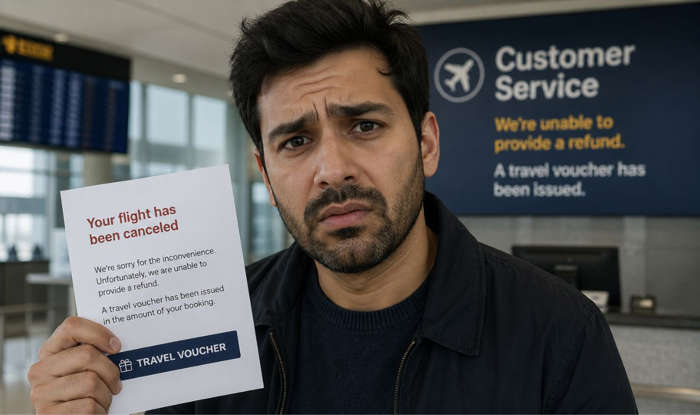
What to Do When Your Flight Is Cancelled and the Airline Offers a Voucher
Airlines count on the chaos of a cancellation to make a voucher feel like the only option. Before you sign anything, here is what you are actually owed, and how to claim it.
It happens fast. The board flips. A gate agent picks up the microphone. Your flight, the one you planned around, booked six weeks ago, and packed for at midnight, is canceled.
Before you have even registered what that means for your afternoon, someone in a uniform is sliding a piece of paper across the counter, or a push notification is landing on your phone, presenting you with what looks like a reasonable offer: a travel voucher.
Trending Now!!:
Most people take it.
That is usually a mistake.
The moments immediately after a cancellation are when airlines collect the most savings. Not through bad faith, necessarily, but through speed and the natural human instinct to resolve discomfort quickly. Understanding what you are actually owed, and what that voucher really represents, is the difference between recovering your money and handing it to the airline indefinitely.
This guide is not built on policy language alone. It draws on years of observing how airlines operate during disruptions, what actually works at the counter, and what passengers consistently get wrong when their itineraries collapse.




Why Airlines Offer Vouchers Before They Offer Refunds
The travel voucher is not a gesture of goodwill. It is a financial instrument that serves the airline’s balance sheet far more than it serves yours.
Airlines offer flight vouchers instead of cash refunds to minimize costs during periods of crisis. The advantages for airlines compared to full reimbursement come in the form of significantly lower financial compensation.
When an airline gives you a voucher, it is not paying you anything immediately. It is issuing a liability on its books, one that a meaningful percentage of passengers will never fully redeem. Some vouchers expire before they are used. Others come with blackout dates, route restrictions, or fare class limitations that make them practically worthless for the trip you actually want to take.
Many passengers later regretted accepting vouchers. Vouchers often have short expiry dates, becoming impossible to use. Accepting one can also eliminate your chances for compensation or a refund you should have received in cash.
The math, when you look at it plainly, almost never favors the voucher. And yet, standing at a chaotic gate surrounded by hundreds of equally frustrated passengers, the voucher feels like the quickest exit from a bad situation. That emotional logic is exactly what airlines are counting on.
Your Legal Right to a Cash Refund in the United States
Here is what the law actually says, stripped of the fine print airlines prefer you never read.
If an airline cancels your flight, for any reason whatsoever, you are entitled to a full cash refund to your original form of payment. This applies even to non-refundable tickets. This is not a courtesy. It is a federal consumer protection backed by the U.S. Department of Transportation.
Airlines and ticket agents must provide refunds in cash or whatever original payment method the individual used to make the purchase. Airlines may not substitute vouchers, travel credits, or other forms of compensation unless the passenger affirmatively chooses to accept alternative compensation.
That last phrase carries the full weight of the rule. The passenger must affirmatively choose the alternative. If you accept a voucher, you have made that choice. If you do not, you have not.
Under DOT rules, airlines are required to notify you about flight cancellations and your right to receive a refund. The automatic refund must be provided within 7 business days for credit card purchases, or 20 business days for cash purchases, after the airline becomes aware that you do not accept the alternative.
Under DOT policy, airlines offering passengers a voucher or some other form of compensation as an alternative to a refund must clearly explain to the passenger that they are entitled to an actual cash refund if that is what they want. If an agent presents you with a voucher without mentioning the cash option, that is a compliance issue, and you are under no obligation to pretend otherwise.
What Counts as a Significant Disruption?
“Significant disruptions” are clearly defined across all airlines as a delay of three hours or more for domestic flights and six hours or more for international flights. If a bag for a domestic flight is delayed for more than 12 hours, or 15 to 30 hours for international flights, travelers are eligible for refunds on bag fees.
This definition matters because airlines sometimes attempt to rebook passengers on flights that technically reach the destination but do so hours later and with additional stops.
A rerouting through a different hub, a significant change in departure time, or a downgrade in cabin class can all qualify as a significant change, triggering your refund rights regardless of whether the word “cancelled” appears on the departure board.
The Controllable vs. Uncontrollable Distinction
This is where airline passenger rights in the United States get genuinely complicated, and where the gap between what you are owed and what you will comfortably receive narrows considerably.
Rebooking, meals, hotels, and other services are provided by airline policies in case of a controllable flight cancellation. A cancellation is considered controllable when it is caused by the airline itself. Examples include maintenance issues and airline staffing problems. Uncontrollable factors include severe weather conditions, air traffic control decisions, and security concerns.
The cash refund right applies regardless of which category your cancellation falls into. You are owed your money back, whether a snowstorm grounded the plane or an aircraft mechanical failure did. What changes between controllable and uncontrollable events is what the airline owes you beyond the refund, specifically meals, hotel stays, and ground transportation.
In case of a controllable cancellation, all ten major U.S. airlines commit to rebooking on the next available flight of the same airline at no additional cost. Several, including Alaska, Delta, JetBlue, and United, have also committed to hotel accommodations and meal vouchers when the cancellation is within their control and causes an overnight disruption.
If your flight is canceled due to weather, that hotel voucher is far less certain. The airline is not legally required to house you. Some will, as a goodwill measure. Many will not. Knowing this distinction in advance changes how aggressively you advocate for yourself at the counter.
Travel experts regularly recommend booking flights with a credit card that offers trip delay and interruption insurance, so that if something comes up, you are covered. That credit card coverage often steps in precisely where airline obligation ends.
EU261: When Your Rights Are Dramatically Stronger
If any part of your journey departs from a European Union airport or arrives in the EU on an EU-based carrier, the regulatory landscape shifts significantly in your favor.
Under EU261, if your flight is canceled with less than 14 days’ notice, and it is the airline’s responsibility, you are entitled to both a full refund and financial compensation of up to €600, depending on flight distance. Airlines may offer vouchers instead, but if you accept, you could lose the right to that additional compensation.
EU261 also entitles passengers to the “right to care” while they wait for a rebooked flight. This includes telephone calls, emails, or internet access, meals and refreshments in reasonable relation to the waiting time, and hotel accommodation if an overnight stay is required, plus transportation to and from the hotel. These entitlements apply from the moment the cancellation is confirmed.
The practical lesson here is one that cannot be overstated: accepting a voucher in an EU-covered context may cost you hundreds of euros in additional compensation you were legally entitled to. A passenger flying from London to Rome who accepts a £100 voucher, for instance, may be walking away from €250 or more in statutory compensation plus a full refund of the original ticket price.
Keep all receipts. Meals, transport, and accommodation incurred while waiting for a replacement flight are reimbursable, even when the airline does not proactively distribute vouchers for those expenses.
How to Handle the Counter, Practically
Knowing your rights is one thing. Exercising them under fluorescent airport lighting, with a gate agent managing 300 frustrated passengers, is another. These are the practical moves that consistently produce better outcomes.
Say the Right Words First
The moment a cancellation is confirmed, your opening line at the counter or on a customer service call matters. Say clearly: “I would like a full cash refund to my original payment method under DOT regulations.” If you are in Europe: “I am declining the voucher and requesting a cash refund under EU261.” This language signals that you know the rule and are invoking it deliberately, which changes the dynamic at the counter.
Do not begin with complaints about the inconvenience. Lead with the specific request.
Document the Cancellation Immediately
Screenshot your flight status with a timestamp. This is your primary evidence. If your rebooking dispute goes further, either through a credit card claim or a DOT complaint, that timestamp document is often the most useful piece of supporting material you will have.
Ask About Controllability Directly
Ask the gate agent or customer service representative whether the cancellation is classified as controllable. The answer determines whether you are entitled to meal vouchers and hotel accommodation beyond the base refund. In a controllable situation, ask specifically: “Can I get a meal voucher while I wait?” and “If there is no flight tonight, will the airline cover a hotel?”
Travel experts note that many gate agents have more discretion than they initially suggest, especially during major disruption events when the airline’s own network is overwhelmed. Sending a direct message to a carrier on social media during massive disruptions can also be effective, as it bypasses long counter queues.
Explore Rebooking on Another Carrier
You have the right to ask to be rebooked on a partner airline or even a competing carrier if the wait on the original airline is unreasonable, though airlines are not legally required to honor this request. The willingness to accommodate interline rebooking varies by airline and situation.
This is worth asking about explicitly, particularly during large disruption events where an airline’s own schedule may not recover for 24 to 48 hours. Some airlines will endorse your ticket onto another carrier rather than strand you for a full day.
When a Voucher Actually Makes Sense
This piece has spent considerable space explaining why vouchers usually work against you. But there are genuine cases where accepting one is the rational choice.
If you fly the same airline frequently, travel regularly within a short window, and the voucher carries no meaningful restrictions, it can deliver fair value. Some experts note that if it is a quick trip you know will be impacted, it can sometimes be best to cancel, get an airline voucher for the cost of the ticket, and travel another time.
Travel credits and vouchers offered by airlines must be valid for at least five years, and airlines must disclose any material restrictions, limitations, or conditions on the credits. If the airline confirms in writing that your voucher has a five-year validity, covers any fare class, and applies to any route the carrier operates, the flexibility gap between a voucher and cash narrows considerably.
The question to ask yourself before accepting is simple: will I actually use this with this specific airline, on a route they fly, within the validity period? If the honest answer is no, ask for the cash.
One specific scenario where vouchers make particular sense is when an airline offers a voucher worth more than the original ticket, as an added incentive to accept the alternative. Some carriers, during high-disruption periods, have offered vouchers valued at 150 percent or more of the ticket price. If that is the case, and the restrictions are genuinely manageable, the calculus shifts.
The Credit Card You Should Have Used to Book the Flight
If there is a single structural lesson embedded in every flight cancellation story, it is this: how you paid for the ticket matters as much as any airline policy.
A credit card that offers travel insurance protections can be crucial, and it really eliminates the financial stress of flight troubles. Trip delay insurance, trip cancellation coverage, and travel interruption benefits are embedded in dozens of premium travel credit cards and activate precisely in the situations where airline’s obligation ends.
If your flight is canceled due to weather, the airline owes you a refund, but nothing else in the United States. Your credit card, if it carries the right protections, may cover the hotel, the meals, and the alternate transportation you booked independently. Read the benefits guide for the card you use to book travel. Most people discover those protections exist for the first time during the disruption, which is the worst possible moment to be reading the fine print.
Filing a Complaint with the DOT
If an airline refuses a cash refund you are legally entitled to, you are not without further options.
Passengers who feel they have not been treated fairly by an airline, or who feel their refund request has been unfairly rejected, can file a complaint with the DOT.
The DOT’s Aviation Consumer Protection Division receives and processes these complaints, and a documented pattern of refund denials from a single carrier can trigger regulatory action. Individual complaints also carry weight when a passenger’s dispute reaches the airline’s internal resolution team, as carriers prefer to resolve complaints before they become formal DOT records.
If an airline stonewalls you on a cash refund, filing a complaint with the DOT’s Aviation Consumer Protection Division is the appropriate escalation path.
The complaint process is available at transportation.gov and takes roughly 15 minutes to complete. Bring your booking confirmation, the cancellation documentation, records of any communication with the airline, and a clear account of what you requested and what response you received.
The Bigger Picture on Passenger Rights in 2026
The final DOT refund rule created certainty for consumers by defining the specific circumstances in which airlines must provide refunds. Prior to this rule, airlines were permitted to set their own standards for what kind of flight changes warranted a refund, which made it difficult for passengers to know or assert their refund rights.
The current regulatory environment in the United States offers more passenger protection than existed five years ago. The automatic refund requirement, the clear definition of significant delays, and the mandatory disclosure of refund rights represent genuine improvements.
What the U.S. system still lacks, and what European regulation provides, is mandatory financial compensation beyond the refund when an airline causes a cancellation. Proposed rules that would have required U.S. airlines to pay passengers additional cash compensation when the carrier caused a cancellation or major delay were not moved forward under the current administration.
That gap, between a refund and actual compensation for the disruption to your time, travel plans, and the expenses that cascade from a canceled flight, is why travel insurance and the right credit card remain essential tools for any frequent flyer. The law gives you the floor. You have to build the rest of the protection yourself.
The Short Version for the Gate Right Now
If you are reading this at an airport with a canceled flight on the board, here is what to do in sequence.
Do not accept the voucher until you have asked about your cash refund option. Tell the agent you are invoking your DOT refund rights, or your EU261 rights if you are departing from a European airport. Screenshot the cancellation notice with the time stamp visible.
Ask whether the cancellation is controllable and, if it is, ask for a meal voucher and hotel accommodation if applicable. If you are rebooking, ask whether other carriers can be considered. Save all receipts for any expenses you incur while waiting. If you are refused a cash refund and believe you are entitled to one, file a DOT complaint after the trip.
The airline’s first offer is rarely the best one available to you. The passengers who walk away whole from a cancellation are almost always the ones who knew that before they needed it.
What People Ask