
He Admitted the Price Was a Lie, Then Made Me Feel Lucky for Paying It
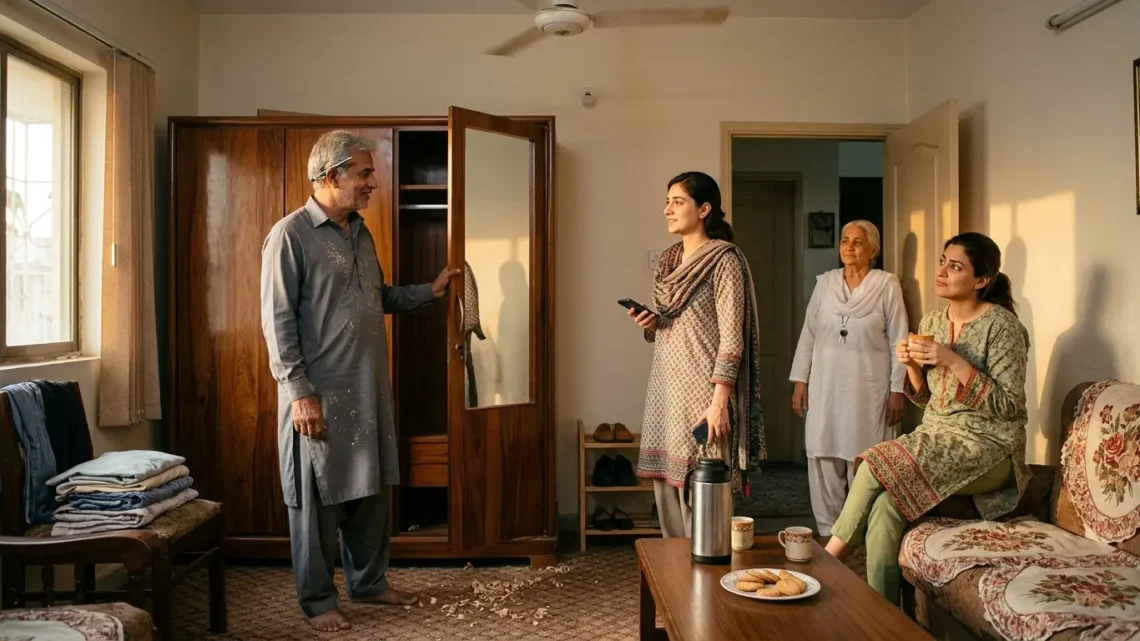
Eighty-five thousand? Hina set her chai down on the arm of my sofa. For this?
She knocked twice on the wardrobe door. The sound was flat and hollow, like a cupboard in a hospital corridor.
Trending Now!!:
I had been in Karachi for seven months by then. I had a job at a logistics company on Shahrah-e-Faisal, a flat in Gulshan-e-Iqbal, and a landlord who called at nine sharp on the first of every month. I also had a wardrobe I had been quietly proud of for six weeks.
Hina was my cousin. She had lived in this city her whole life and had opinions about what everything should cost.
My neighbour in North Nazimabad got the same one made for fifty-two, she said. Same size. Same sliding mirror. Wait, I will send you the picture.
My phone buzzed on the table.




It was a WhatsApp photo of a stranger’s wardrobe, and it looked almost exactly like mine. Even the handles matched. My face went warm, and I looked at the carpet.
I had found Ustad Jameel through the chowkidar of my building, who wrote his number on a torn corner of a cigarette box.
The workshop sat behind a tyre shop off Rashid Minhas Road. It smelled of sawdust, varnish, and the samosas frying next door.
Jameel was around sixty, with a pencil behind each ear and a tape measure he mostly ignored. He measured my wall with his hand span, muttering numbers, then said the price without looking at me.
Eighty-five thousand, baji.
I told him I had heard sixty. He put his hand on his chest as if I had slapped him.
I am not a shopkeeper, he said. You want cheap, go to the furniture market and buy something that dies in two years. I make things that stay.
Then he turned back to his plank of wood, which was how I knew the conversation was over. I said okay. I actually said sorry, to a man for asking about a price.
I sent 40,000 as an advance through Easypaisa right there on the stool. Jameel read the confirmation message aloud, slowly, like a prayer, and promised delivery in three weeks. It came in four.
On Saturday morning I went back to the workshop with Hina’s photo saved on my phone and a speech ready in my head. I rehearsed it on the walk past the tyre shop. In my head I was calm and a little cold, like a woman in a drama who has seen the receipts.
Jameel saw me at the gate and lit up.
Baji! Is the door sticking? Tell me, I will come tonight with my boy.
No, the door is fine, I said. I held out my phone. My cousin’s neighbour paid fifty-two thousand for this.
He took the phone and looked at it for a long time. He zoomed in with two fingers, which I had not expected him to know how to do. Then he sighed, the sigh of a man who has been waiting years for someone to finally ask.
Fifty-two, he said. Of course. Did they tell you what is inside it?
I said no.
Board, baji. Pressed sawdust and glue with a sticker on top. Spill one glass of water on that and it swells like bread in two monsoons. He handed the phone back. Yours has a sheesham frame and kikar wood inside. German hinges.
It sounds hollow, I said. My speech was already coming apart.
Hollow is the air between two good panels, he said. That is how you stop warping in Karachi humidity. Fifteen years in this city, you think I don’t know the weather?
I did not know what to say, because it sounded true. That is the problem with a good answer. It does not have to be true to work.
He walked me to the shop’s display door, a sample he kept leaning on the wall, and swung it open. It closed with a soft sigh, all by itself.
Listen, he said.
I listened. It was a very good sigh.
Your cousin is worried about you, and that is good, he said. Family should worry. But worry is free, baji. Furniture is not.
I laughed. I do not know why I laughed.
Now I will tell you something I did not want to say, he went on, lowering his voice. My real price for that wardrobe is ninety-five. I gave you ten off because you remind me of my daughter. Ask anyone on this road.
I had walked in feeling cheated. In about four minutes I was grateful. He made me a fresh cup of tea from the flask under his bench and gave me a small shoe rack he said he had left over from another job. I carried it out in both arms and said thank you twice.
In the rickshaw home I opened Daraz and searched for soft-close hinges. A pair cost 380 rupees. I had counted six hinges in my wardrobe, which made the German hardware about 1,140 rupees out of 85,000.
That proved nothing. Hinges are cheap everywhere, and the money is in the wood. I could not see the wood. I could only see the outside of it and trust the man who had cut it.
That night I opened the wardrobe and tapped the back panel with one knuckle. I tried the side, then the shelf, then the back again. They all sounded the same to me.
I stood there in my socks, tapping a piece of furniture in the dark like a doctor who had never been to school.
I told Hina everything the next day. She listened with her mouth getting smaller and smaller.
He is lying, she said. He is a liar, Sana. A very good one.
I said maybe. I said the sigh of the door was real.
Anyone can buy a hinge, she said.
Three weeks later she sent me a photo without a caption. It was her neighbour’s wardrobe in North Nazimabad, and one door hung crooked from its frame, with a gap at the top you could slide a finger through. Hina sent it with no comment. For Hina, that is a speech.
I did not know what to do with the photo. The cheaper wardrobe had failed, so maybe Jameel had told the truth about the wood. Or maybe the neighbour had simply hired a bad carpenter, and my forty extra thousand had gone into Jameel’s pocket and nowhere near the wardrobe.
Both stories fit. I stopped trying to prove either one.
Yesterday Mrs. Anwar from the flat downstairs caught me on the stairs. She is seventy-one, she keeps her house keys on a chain around her neck, and her son in Toronto had finally sent her money for a new bedroom set.
Beta, your wardrobe is beautiful, she said. Who made it? I don’t trust anyone anymore.
My phone buzzed in my pocket before I could answer. It was Jameel.
Baji, shaadi season is coming. Send me your friends. I will treat them like family.
I stood on the landing with Mrs. Anwar waiting, her hand on the railing, her eyes full of trust. I found his contact and pressed share. A message box opened under it.
I typed: Tell him I sent you.
My thumb stayed over the screen for a long time. I thought about adding another line, the one I actually wanted to write.
Some people sell you furniture. The good ones sell you the feeling that you were clever to buy it.