
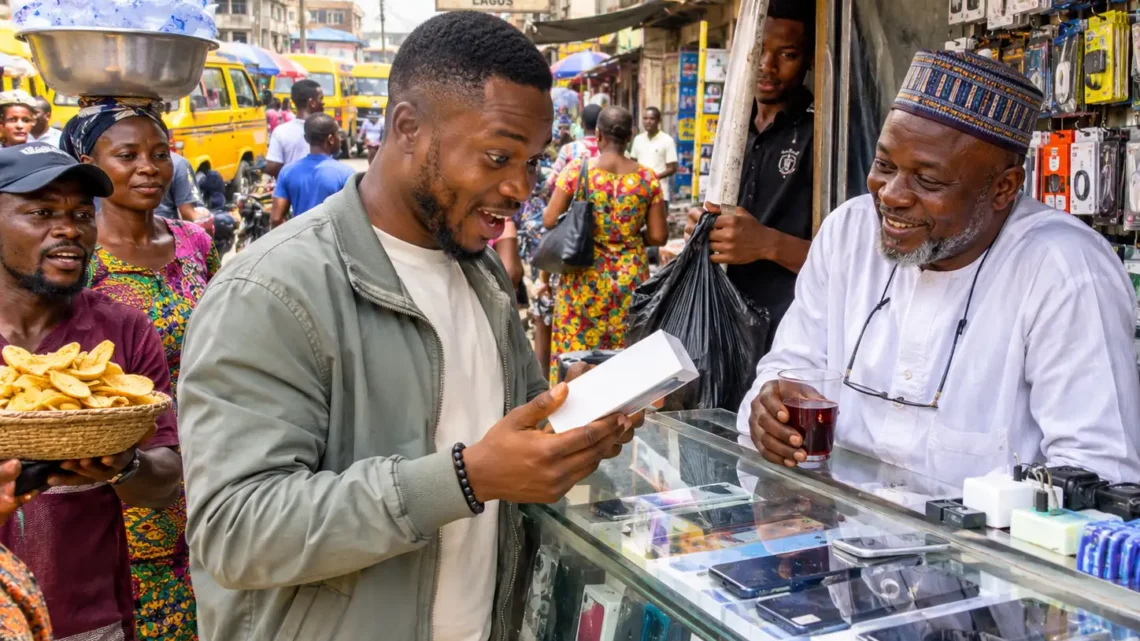
I Said Nobody Could Scam Me in Lagos, Then a Phone Seller in Ikeja Sold Me a Box of Fufu
I told Segun nobody could scam me in Lagos, and I said it with my mouth full of Gala.
We were standing outside a Moniepoint POS spot near Allen Roundabout in Ikeja. I had just collected ₦265,000 in cash, and I was holding it inside my jacket like a newborn baby. Eight months of saving. Eight months of walking one bus stop to avoid paying an extra ₦200, of eating Indomie with egg on payday and without egg on every other day.
Trending Now!!:
My old phone had a screen like a spider web. The battery died at 40 percent whenever it felt like it. Last week it died in the middle of a Bolt ride, and I had to find cash I did not have.
Just go to a proper shop, Segun said. A real store with a receipt. Pay the extra.
Extra how much? I said. ₦120,000? What for? Air conditioning?
Peace of mind, he said.




I was born in Surulere, I said. I have entered danfo at six in the morning in the rainy season. I have watched a man lift a wallet in Oshodi using a newspaper. Nobody can scam me in Lagos.
Segun looked at me for a long time. Then he took another bite of his Gala and said, Okay, Mr Street Wise.
Computer Village does not begin at a gate. It begins when the first boy grabs your arm and says, Oga, what do you want? I get am. By the time I reached Otigba Street, three of them were walking with me, one on each side and one behind, like a small unpaid police escort.
The air smelled of roasted corn, hot solder and gutter water. Somewhere a speaker was playing Afrobeats too loud for its own size. A woman balanced a bowl of sachet water on her head and still managed to shout the price at me.
I ignored every boy and picked my own shop. This was my first trick: never follow the one who calls you.
The man behind the glass counter was called Kabiru. He was maybe fifty, in a clean white kaftan, with reading glasses hanging on a string and a small cup of zobo in his hand. He looked like somebody’s uncle. He looked like the kind of man who still sends his children money.
iPhone 13, I said. UK used. Clean one.
Ah, very clean, Kabiru said. ₦340,000.
I laughed so loudly the woman at the next stall looked up from her screen guards.
We went back and forth for twenty-five minutes. I walked away twice. He called me back twice. That is the dance, and I knew every step. Finally he sighed like I was taking food from his children and said ₦265,000.
Then I did everything right. I made him open the box in front of me. I powered on the phone. I dialled *#06# and matched the IMEI with the sticker on the box. Battery health, 91 percent. I tested the camera, the speaker, the charging port and Face ID. I made him pull out the SIM tray. I ran my thumb over every inch of the screen.
Kabiru watched all of it with a very calm face. He did not hurry me once. I remember thinking, this man has nothing to hide.
I counted the money twice. He counted it twice after me.
Oga, let my boy pack am well for you, Kabiru said. Original box, original tissue paper. Black nylon so thief no go see.
A boy of about sixteen took the phone and the box and stepped through a curtain at the back of the stall. I watched that curtain. I want to be clear about this. I watched it the whole time, maybe two minutes, except for one moment when a hawker pushed a bowl of plantain chips against my chest and asked if I wanted some. Five seconds. Maybe less.
The boy came back with a black nylon bag, tied twice at the top. It was heavier than I expected. I remember thinking, these boxes must be solid.
Kabiru shook my hand with both of his. Come again, my brother. Tell your friends.
I walked out of Computer Village like a man who had just won an election. I took a Bolt back to Ogba with the bag on my lap the whole way, both hands holding it. Then I sent Segun a voice note: Collect your apology. Brand new iPhone, ₦265k, battery 91. Lagos cannot touch me.
I worried I had spoken too fast, so I sent a second one saying the same thing slower.
My flatmate Emeka was on his bed with a plate of rice when I got home. I placed the bag on the table like a trophy and untied the knots. Black nylon, then the white box with the picture of the phone on it. The plastic wrap was still tight and shiny. I cut it with my door key, and I swear to you it had never been opened before.
I slid the lid off. White tissue paper, folded neat, exactly how I liked it.
Under the tissue was a second nylon, thin and clear, knotted at the top. Inside it sat a pale, smooth lump the size of a fist and a half.
It was still warm.
I knew the smell before my brain caught up. Cassava, soft and a little sour. Fufu.
Emeka stopped chewing. Tunde, is that, he said, and he did not finish, because I was already shaking the box, lifting the tissue, checking the lid, checking under the lump like the phone might be hiding behind it. There was no phone. No cable, no charger, no SIM pin. Just a very good box with a very good wrap and a warm fufu inside.
I sat down on the floor of my room in Ogba. I looked at my old phone, with its spider web screen, lying on the bed, and I did not know whether to laugh or to cry.
I did both. In that order.
Segun answered my call on the first ring. I told him the whole story, and he was quiet for exactly four seconds. Then he sent me a voice note of himself laughing. It was forty-seven seconds long. I know because I played it three times.
Mr Street Wise, he said at the end, still wheezing. Did it at least come with soup?
Around nine that night, hunger beat pride. Emeka had leftover ewedu and stew in the fridge, so I warmed it and ate the fufu, all of it, sitting on the same floor. It was good fufu. Smooth, no lumps, no hardness at the centre. That is the part that bothers me most.
I did not sleep. I kept going back through the afternoon, frame by frame. The curtain. The plantain chips. The weight of the bag. I still cannot tell you how they did it. The shrink wrap was intact. The phone worked in my hand. Fufu does not fall out of the sky.
Next morning I went back to Ikeja with a plan. I would shout. I would record everything on my cracked phone and post it on Instagram and tag every account in Lagos with more than ten thousand followers.
Kabiru was in the same place, in the same kaftan, with the same glasses and the same small cup of zobo. When he saw me, he smiled like I was his favourite nephew.
My brother! he said. You came back. Welcome.
You sold me fufu, I said. My voice came out thinner than I wanted.
He did not argue. He did not even look surprised. He just came around the counter, put his hand on my shoulder and walked me three steps away from the stall, near the alley where the sun did not reach.
Listen, he said, very softly. I like you. You checked everything. Most people no check anything. Na why I respect you.
Where is my phone?
Market no get refund, he said. But I no want you to go home with nothing.
He pulled a thick fold of ₦1,000 notes from his kaftan pocket, held together with a red rubber band. He pushed it into my palm and closed my fingers over it with his own.
₦60,000, he said. Go and buy small phone in Ojota. No video. No post. No police. You understand me?
The recording light on my old phone was already on, inside my jacket pocket, pointed at his face. He did not know. Or maybe he did.
I stood there in an alley in Ikeja with ₦60,000 in one hand and my thumb over the red button with the other. ₦205,000 was gone either way. A boy was watching us from the stall, chewing something slowly. Somewhere behind me a woman was shouting the price of sachet water.
I thought about eight months of Indomie.
I thought about my thumb.
The city did not take my money that day. It took my sentence.