My Plan Was Perfect. The World Had Other Ideas
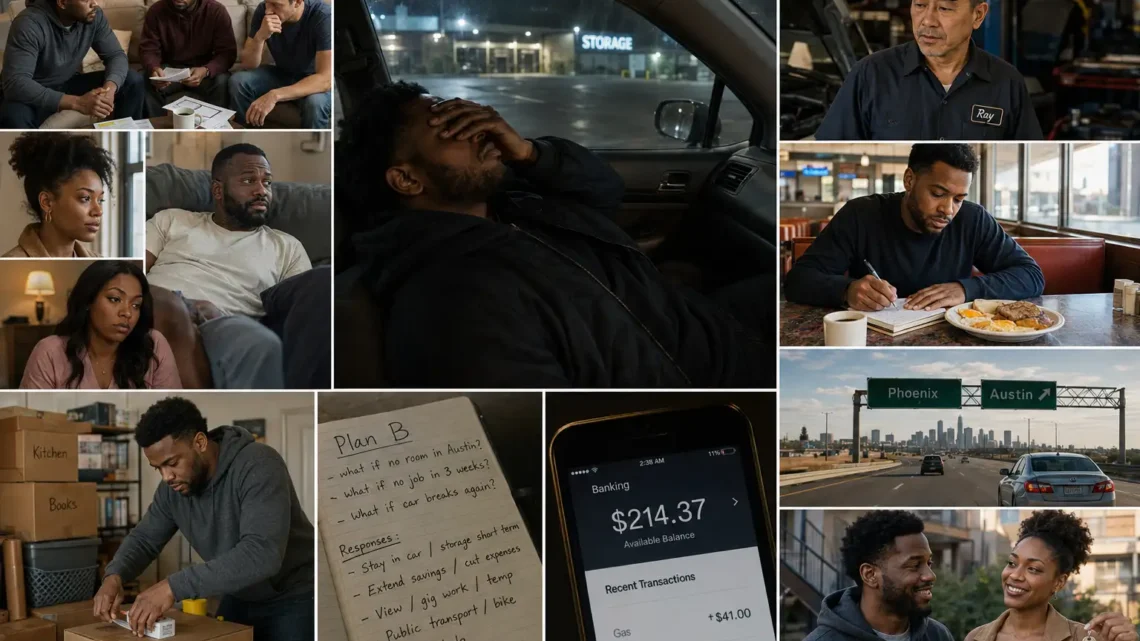
I want to tell you about a Tuesday night in February when I was twenty-seven years old, parked outside a storage facility in Phoenix, Arizona, sleeping in the back seat of a 2009 Honda Accord with a jacket over my face and approximately $214 in a bank account I was afraid to check.
I was not homeless in the way people picture when they hear that word. I had a plan. I kept telling myself that. I had a plan.
Trending Now!!:
The plan was this: I had just left a job I had held for three years managing inventory at a medical supply warehouse. The job paid just enough to keep me comfortable and just little enough to keep me broke.
I had saved $4,000 over fourteen months, which felt like a significant amount until the apartment lease I was sharing with two roommates ended suddenly, because one of them, a man named Terrence, had been secretly not paying his share of the rent for four months and our landlord had finally caught up with all three of us at once.
So I was out. Not from the job, not yet. But out of the apartment, and unwilling to sign a new lease on my own because I had already been making plans to leave Phoenix entirely and move to Austin, where a friend of mine named Deja had been telling me for two years that the job market was different, that opportunities were organized differently there, that people who showed up with a skill set and a willingness to work could find traction faster than in cities where every opening had five hundred applicants.
I had already given two weeks notice at the warehouse. I had already shipped a box of books and kitchen items to Deja’s spare room. I had already mapped the drive.




What I had not done was account for the transmission.
Three days before I planned to leave, the Accord’s transmission started slipping on the highway. The mechanic, a quiet man named Ray who ran a shop out of a converted gas station on Camelback Road, told me with the calm of someone delivering weather forecasts that the repair would cost between $1,800 and $2,400 depending on what he found once he opened it up.
I authorized the work. I had no choice. The car was the plan.
That left me with somewhere between $1,600 and $2,200, a move to make, no apartment to return to, and a departure date I had already told people about.
So I called Deja and told her the situation. She was sympathetic in the specific way that people who are genuinely busy can be sympathetic: full of warmth and short on practical alternatives.
Her apartment had one spare room, and her cousin from Memphis had already claimed it for the month. She said she would figure something out by the time I arrived. I told her not to worry.
I told my friend Marcus, who offered his couch, but Marcus lived with a woman named Portia who I had once said something mildly critical about at a barbecue, and the energy in that apartment since then had always been faintly cold on her side. I thanked him and told him I would manage.
That left me sleeping in the Accord outside the storage facility where I had put my furniture, which was mostly IKEA pieces I had assembled the first time incorrectly and then never fully trusted.
The first night was the hardest.
Not because of the discomfort, exactly. The back seat of an Accord is not designed for a five-foot-eleven adult, and my lower back made its opinion known around three in the morning. But the physical part was manageable. What was harder was the narrative.
I was someone who had always believed, with the quiet certainty of a person who has never been seriously tested, that I made smart decisions. I researched things. I made spreadsheets. I considered contingencies. I was the friend people called when they needed to think something through.
And here I was, twenty-seven years old, sleeping in a parking lot in a city I was leaving in four days, with a jacket over my face and a phone at eleven percent battery I was afraid to charge because the car needed to conserve fuel.
At around four in the morning, I stopped trying to sleep and just lay there looking at the ceiling of the car, listening to the distant sound of a freeway and the occasional beep of the storage facility’s security system, and I had a very specific thought.
The thought was: you planned for everything except what actually happened.
That was it. That was the whole thing. I had mapped the route to Austin. I had researched neighborhoods. I had a copy of my resume on a USB drive in the glove compartment. I had thought about gas money, about the first month’s expenses, about how long I could live off savings while I found work.
I had not thought about the transmission. I had not thought about Terrence and his accounting irregularities. I had not thought about what happened if both things occurred within five days of each other.
The plan had been built entirely for a world where nothing unexpected happened. Which is to say, it was not really a plan at all. It was a schedule.
Ray called me at 8:47 the next morning and told me the final repair cost was $1,950. I told him to go ahead. He had the car ready by three that afternoon.
I drove to a diner nearby and sat in a booth for two hours drinking coffee and eating a plate of eggs I could not fully afford, and I started building a new plan. Not a schedule this time. An actual plan, meaning a document that acknowledged the possibility of things going wrong and had responses prepared.
I wrote down every assumption I had been operating on and asked myself what would happen if each one failed. What if the spare room in Austin was not available when I arrived? What if I didn’t find work for six weeks instead of three? What if the car needed another repair before winter?
For each question, I wrote a response. Not a perfect response. Not even a comfortable one. But a response.
I left Phoenix on a Thursday morning with $247 in my account and a full tank of gas that cost me forty-one dollars I had been holding back for exactly this moment.
The drive to Austin took eleven hours. The Accord ran perfectly.
Deja met me in the parking lot of her complex with a key to a neighbor’s studio apartment, a woman named Gloria who had gone to visit family in Houston for the month and had agreed to let me use the place for four weeks in exchange for a contribution toward utilities that Deja and I worked out together.
I found a job fourteen days later. Not a great one, not immediately. But a real one, with hours, and a manager who was organized, and a role that used skills I actually had.
I have thought about that parking lot outside the storage facility many times since then. Not with shame, exactly. With something closer to respect for the version of myself that lay in the back seat at four in the morning and did not fall apart.
He stayed. He thought. He wrote down his assumptions in a diner the next day and challenged every one of them.
The lesson I took from those four days was not that plans are useless. Plans matter. Research matters. Saving money matters.
The lesson was that a plan built only for favorable conditions is a comfort document, not a strategy. Real planning accounts for the transmission. Real planning names the Terrence scenario and has a quiet response ready for when it arrives, as it always does, and always at the wrong time.
I still make spreadsheets. I still research things thoroughly. I am still the friend people call when they need to think something through.
But now I always add one more column to whatever I’m building. I label it: “What if the thing I’m not expecting happens?”
And I fill it in before I leave the driveway.