The Widow Who Fought an Insurance Company for Three Years and Won
We regret to inform you that your claim has been denied.
The woman from Pacific Crown Life read it off a screen. I could hear her typing something else while she spoke. I was standing in my kitchen in Quezon City, Manila, still holding the rice cooker lid, while my son asked from the next room if there was any garlic rice left.
Trending Now!!:
Rodel had been dead for eleven weeks. The policy was for one million five hundred thousand pesos. I had never said that number out loud to anyone, because it felt like bad luck.
The records show your husband was treated for hypertension and did not declare it, the woman said. This is material concealment. The policy is void from the start. We can refund the premiums paid.
Ten months of premiums, she told me. Eighteen thousand five hundred pesos. I said okay and then I said thank you, and I hated myself for the second one for about three years.
Rodel drove a delivery van for a hardware supplier in Valenzuela. He was forty-three. He collapsed at the loading bay between a stack of PVC pipes and a pallet of paint cans, and by the time the van from the funeral parlour came to our street, half the neighbours were already standing outside in their house slippers.




The funeral cost sixty-two thousand pesos. I borrowed thirty thousand from Perla, who lends on the street at what everyone calls five-six. Borrow five, return six, every cycle, and the cycle comes round faster than you think.
I took a job as a cashier at the Puregold on Commonwealth Avenue. Twelve-hour shifts, standing, a plastic stool I was not allowed to use. Rent in Barangay Culiat was nine thousand five hundred. Rice went up again that month, and Anika, who was nine, asked why the rice had got smaller.
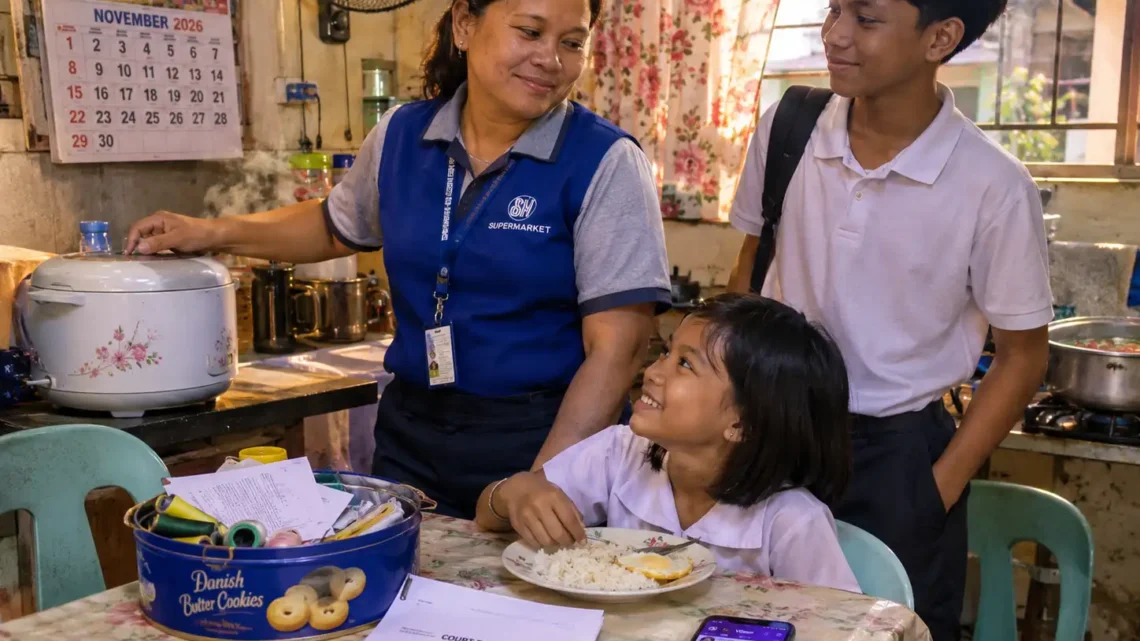
The policy papers lived in a blue Danish Cookies tin with the sewing thread and the spare buttons. Every Filipino home has one, and no one has ever found cookies inside. I took everything out and laid it on the bed and read it like it was a letter from him.
I wrote to the company. They said no. I wrote again, and they said no again with a different reference number. At their office in Makati the air conditioning was so cold I kept my bag on my lap like a shield, and the guard gave me a ticket, number forty-seven, as if I was there to pay a bill.
Ms. Villanueva from claims called me ma’am eleven times in one meeting. I counted. She told me she understood my situation, and I wanted to ask her what exactly she understood.
My cousin knew a lawyer, Dolores Cruz, who had a small office above a dental clinic. She charged three thousand pesos a hearing, then quietly stopped charging me for some of them. She filed a complaint with the Insurance Commission on United Nations Avenue, and then came the waiting.
Hearings were postponed. Documents went missing and were found again. A year went by, and the interest on Perla’s money had turned thirty thousand into something I stopped looking at.
In the fourteenth month, the company offered two hundred thousand pesos. Take it and sign that it was final, or keep fighting and maybe get nothing. I sat in Dolores’s office with the offer letter and did the arithmetic on my phone. Two hundred thousand would clear Perla, clear the funeral, and leave me a little to breathe with.
I almost signed. My pen was out.
Jomar, my fourteen-year-old, had come with me because he did not want me riding jeepneys alone with papers. He looked at the letter, then at me.
Ma, Papa paid for ten months, he said. They took his money for ten months.
I put the pen down. Not because I was brave. Mostly because I did not want him to remember me signing.
There was something I had never told anyone, and it sat in my chest the whole three years like a swallowed coin. I knew about the pills. Rodel took amlodipine from the barangay health centre, one small white tablet every morning with his coffee. The night he signed the application, we were at the kitchen table, and I was the one who said it.
Just don’t write the medicine, I said. It’s seven hundred pesos more every month. You feel fine.
He did feel fine. He was forty-three and he laughed at everything. I had said it the way you say something you will never think about again.
I told Dolores all of it, in her office, with my hands between my knees. She listened and wrote one line on her pad. Who filled in the form?
I did not know. Rodel never filled in a form in his life, he just signed where people pointed.
For twenty-two months I did not touch his phone. It sat in the drawer under his reading glasses with the charger wrapped around it. One Sunday Anika was napping and the apartment was quiet, and I took it out and tried her birthday as the passcode. It opened.
I scrolled for a long time through voice notes about lunch, a group chat for the warehouse drivers, a photo of a plate of sinigang with the caption ang asim! Then I found the Viber thread with the insurance agent. His name was Jerome Pascual, and his profile picture was him in a barong at somebody’s wedding.
The message was from the week of the application. I read it four times.
Sir, wag nyo na isulat yung gamot sa BP. Tataas lang premium. Okay lang yan, ako na bahala.
Sir, don’t write down the BP medicine. Your premium will only go up. It’s okay, I’ll take care of it.
Rodel had answered with a thumbs-up and ok po boss, salamat. I sat on the edge of the bed and laughed, and then I stopped laughing and held the phone against my chest like something that was still warm.
I took screenshots, then took the phone to an internet cafe on Tandang Sora and printed every page at ten pesos each. The boy at the counter asked if I wanted them stapled. I said yes.
At the hearing, Jerome sat across from me in a polo shirt that looked borrowed. He did not look at me once. The company’s lawyer said the policyholder had signed the form, and signing means reading, and reading means agreeing.
Dolores stood up and asked one question. Who ticked the box marked no? The room stayed quiet until the lawyer admitted it was the agent.
The decision came in the thirty-fourth month, on a Thursday, by courier. Two pages. The Commission ruled that the company was bound by what its own agent had done, that the claim must be paid in full with interest, and that the agent’s license was revoked.
I read it standing at the gate in my Puregold uniform, and a tricycle driver asked if I was okay. I said yes. It was the first time that word had been true in a long while.
The money came through on a Tuesday. I paid Perla first, in cash, and she counted it twice and did not say a word. I bought Jomar proper school shoes, not the ones with the glued sole. I paid Anika’s school fees for the year in one go and watched the cashier stamp the receipt.
I did not quit my job. I did not buy a house or go to Boracay. I kept most of it in the bank and checked the balance too many times, like a person who has survived something and does not trust the quiet.
Last week a message came through from a number I did not know. Then I saw the profile picture, the barong, the wedding.
Ma’am Lourdes, it’s Jerome. I’m sorry po. My manager gave us quotas, and everybody was doing it, and I was twenty-three. I lost my license and my mother is sick in Marikina and no company will hire me now. Can you please write a letter saying I did not mean it? Even one paragraph po.
I read it standing in the kitchen with the rice cooker lid in my hand, the same lid, the same kitchen. Jomar was in the other room asking if there was garlic rice.
I have typed four replies since then. One says I forgive him. One says no. One says nothing at all except his own message back to him, okay lang yan, ako na bahala. The fourth is just my husband’s thumbs-up.
They are all still sitting in my drafts.
They took three years of my life and called it a process, and the only thing I have left to decide is who I let off the hook.