“You’re Not a Team Player”: Why I Quietly Let My Boss Destroy His Own Career Before I Quit
The first time Marta locked herself inside the office bathroom, she was holding a half-eaten cheese sandwich and listening to her manager explain to someone outside that she was not a team player.
She had been working at the same insurance company in Warsaw for six years.
Trending Now!!:
She knew which printer jammed when the weather was humid, which lift stopped between floors, and which colleague kept everybody’s birthday money in a drawer without ever contributing her own.
She also knew that if she stayed in the bathroom long enough, someone would eventually knock and ask whether she was feeling better.
That was the advantage of working in a place where nobody wanted to know too much about anybody else.
Marta was thirty-four, unmarried, and renting a small apartment in Praga-Północ, on the eastern side of the Vistula River. Every morning, she took the tram toward the city centre, usually standing because the seats were occupied by people who looked as tired as she felt. In winter, her coat smelled faintly of wet wool. In summer, she carried a folded paper fan her mother had bought at a market and insisted was better than air conditioning.




Her life was not particularly unhappy. That was what made it difficult to explain.
She had enough money for rent, groceries, and the occasional coffee that cost more than she believed coffee should cost. She called her mother every Sunday. She had two friends from university who sent birthday messages and occasionally promised to meet for dinner, although the dinners were usually postponed until somebody had a headache, a work deadline, or an unexpected bill.
On paper, Marta was doing fine.
At the office, however, she had become the person everyone blamed when something went wrong.
The problem started with a spreadsheet.
Three months earlier, her department had been given a new system for processing insurance claims. Management announced that it would make everything faster. For the first two weeks, nobody could log in without restarting their computers, and the help desk advised employees to clear their browser history, which solved nothing.
Marta discovered that certain claims disappeared from the system after being marked for review. She reported it to her supervisor, Paweł, who thanked her and told her not to worry.
Two days later, a customer called to ask why a medical reimbursement had not been paid.
Paweł told the department that Marta had failed to complete the claim.
She showed him the email in which she had reported the system error.
He glanced at it.
Yes, I remember this, he said. Still, we need to focus on solutions rather than excuses.
That sentence became a regular feature of her working life.
Whenever a claim disappeared, Marta was asked to explain herself. Whenever she stayed late to correct the records, Paweł praised the team for its commitment. When the department received complaints, he forwarded them to her with a message asking her to take ownership.
She began keeping screenshots.
At first, it was only three or four. Then she created a folder on her desktop called BACKUP, followed by another called BACKUP NEW, because she did not trust herself to remember which one contained the latest files.
She saved emails, timestamps, error messages, and photographs of handwritten notes left beside her keyboard.
Her colleague Ewa, who sat opposite her, noticed.
Are you planning to sue somebody? Ewa asked one afternoon.
Marta was eating a yoghurt that had expired the previous day but still tasted normal.
I am planning to survive until Friday.
Ewa laughed so loudly that a man from the next department looked over.
For a few weeks, the situation seemed manageable. Marta learned which claims needed to be entered twice and which ones required a phone call to the technical team. She started arriving fifteen minutes early, partly because the office was quiet and partly because she could not sleep properly anymore.
Her mother thought she was working too hard.
You should look for another job, she said during one Sunday call.
Everybody is working too hard.
That does not mean you have to.
Marta was washing a saucepan while they spoke. She watched a strip of foam slide down the metal and disappear into the sink.
I cannot just leave because somebody annoys me.
Her mother did not answer immediately.
I did not say somebody annoys you. You have been telling me you hate that place since Easter.
Marta changed the subject.
She had reasons for staying. Her rent had increased by 400 złoty at the start of the year. Her younger brother, Tomasz, was repaying a loan and occasionally asked her to lend him money until payday. She had managed to save enough for a modest emergency fund, but not enough to feel comfortable walking away from a permanent job.
She also had a small, embarrassing hope that somebody would eventually notice what she was doing.
Not a promotion, necessarily. She would have settled for a meeting in which a manager looked at her records and admitted that the system was broken.
Instead, in September, the company announced a restructuring.
The department would lose four positions. Remaining employees would receive new responsibilities, and management would review individual performance before deciding who stayed.
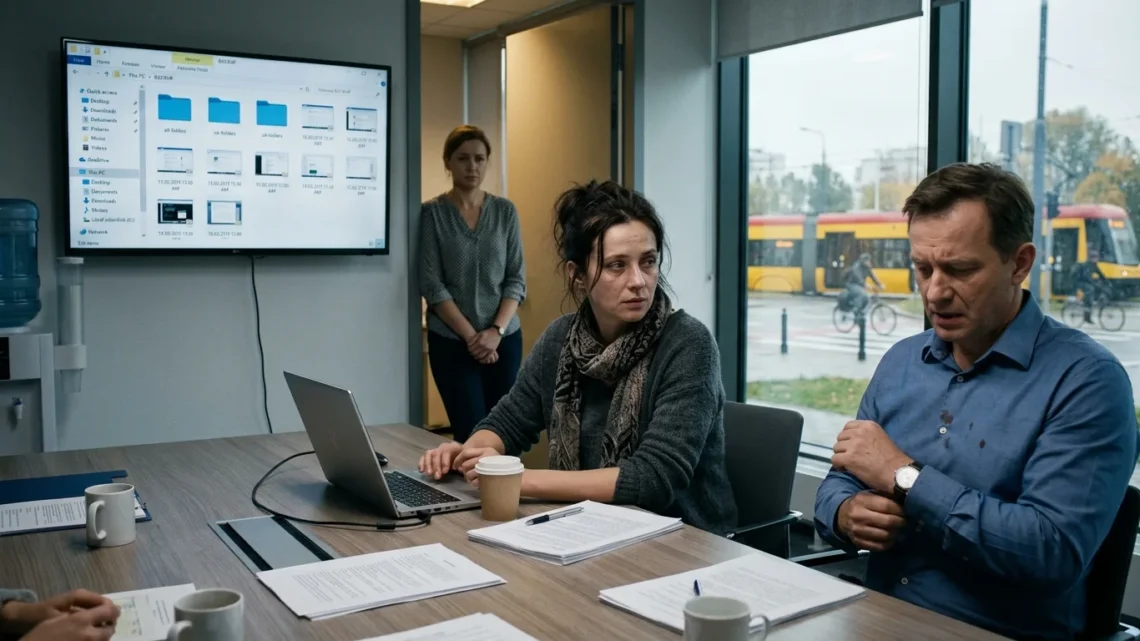
Paweł called a meeting on a Thursday afternoon.
He wore a blue shirt with a small stain near the second button. Throughout the meeting, he kept adjusting his watch and saying that these decisions were difficult for everybody.
We need people who can adapt, he told them. People who bring solutions. People who take responsibility.
Marta looked at the window.
Outside, Warsaw was grey and wet. A tram moved slowly through the intersection, and a cyclist waited beside a delivery van with a plastic bag tied around the handlebars.
She knew what was coming before Paweł said her name.
He told the team that her recent performance had been inconsistent. He mentioned delayed claims, unresolved complaints, and the need for better communication.
Nobody spoke.
Marta felt something strange happen inside her chest. It was not quite fear. It was more like the moment a lift starts moving before you have finished stepping inside.
She opened her laptop.
I would like to show everyone something, she said.
Paweł stopped talking.
She connected her screen to the meeting display and opened the folder she had spent three months building. She showed the dates of the system failures, the emails she had sent, and the claims that had been incorrectly assigned to her.
There were forty-seven documented incidents.
For several seconds, the room was completely quiet.
Then Ewa leaned forward.
Wait. You reported this in July?
June, Marta replied. The first report was in June.
Paweł cleared his throat.
This is not the right forum for discussing technical issues.
Marta looked at him.
You brought up my performance in this forum.
Nobody laughed. That made the moment feel much bigger than it was.
The meeting ended ten minutes later. Paweł told her to come to his office the next morning, and the rest of the team returned to their desks with the careful expressions of people who had just witnessed something they might later be asked to describe.
Ewa followed Marta to the kitchen.
I knew he was unfair to you, she said.
Marta filled a paper cup with water.
You knew he was unfair to me?
Ewa looked uncomfortable.
Well, I suspected.
Marta waited.
You could have said something.
Ewa picked at a loose thread on her sleeve.
I have two children, a mortgage, and a husband who has been talking about moving to another city for a year. I cannot afford to get involved in office politics.
There was nothing unusual about the explanation. That was what made it difficult to dismiss.
Marta nodded, drank her water, and returned to her desk.
The next morning, Paweł did not come to work.
His calendar showed that he was attending an external meeting. Human Resources sent Marta an invitation for the following Monday, with no explanation beyond a request to discuss her role and recent performance.
Over the weekend, she did very little.
She went to a supermarket near her apartment and spent twenty minutes comparing the prices of laundry detergent. She called Tomasz, who asked whether she could lend him 300 złoty because his car needed a new part. She said she would check her account, although she already knew the answer.
On Sunday, she made tomato soup, ate two bowls, and froze the rest in plastic containers. She watched half an episode of a crime series without understanding the plot. At eleven thirty, she opened her work email on her phone, stared at the messages, and closed it again.
On Monday, she arrived early.
The meeting with Human Resources lasted forty minutes. A woman named Joanna listened as Marta described the missing claims and showed her the evidence.
Joanna asked several questions. She took notes. She requested copies of the screenshots and explained that the company would review the matter.
Then she said something Marta had not expected.
We have also received concerns about how you communicate with your colleagues.
Marta blinked.
What concerns?
Joanna glanced at her notes.
That you can be confrontational when challenged. That you sometimes refuse to accept feedback.
For a moment, Marta could not find a response.
She thought about the times she had stayed after work to correct somebody else’s mistake. She thought about the email she had sent at 7:18 p.m. on a Friday, explaining why a claim could not be processed. She remembered Paweł replying with a single sentence asking her to be more constructive.
Did anyone tell you about the system failures? she asked.
We are looking into that.
Did anyone tell you that I reported them before the complaints arrived?
Yes. That is part of the review.
Marta sat back.
She had imagined this meeting differently. In her mind, the evidence would speak for itself, and the people who had ignored it would finally have to explain why.
Instead, she was being asked to defend the tone of her emails.
When she left the building, she walked past the tram stop and continued along the pavement. She passed a bakery where people were buying rolls, a pharmacy with a handwritten notice about opening hours, and a man trying to fit a large television box into the back of a small car.
At a pedestrian crossing, her phone vibrated.
It was Ewa.
Have you heard anything?
Marta typed that she had not. Then she deleted the message and put the phone away.
For the next two weeks, nothing happened.
She received no update from Human Resources. Paweł returned to work and behaved as though the meeting had never taken place. He still sent her claims with missing information. He still reminded the team to be professional. He stopped asking Marta to explain herself in public, but he began copying senior managers into ordinary emails.
She understood the message.
One evening, while waiting for the tram home, she opened a job website. She updated her CV, removed a sentence about being highly adaptable, and applied for two administrative positions.
The first company rejected her the next morning.
The second did not reply.
She nearly gave up on the third application because the salary was lower than her current one. Then she calculated the difference after tax and rent, considered the cost of commuting, and submitted it anyway.
A week later, she was invited for an interview.
The company was a small medical equipment supplier near Mokotów. The office had mismatched chairs, a coffee machine that made an alarming grinding sound, and a receptionist who apologised because the printer had run out of paper.
The interview was ordinary. Two managers asked about her experience, and one asked how she handled mistakes.
Marta almost gave the answer she had prepared about accountability and continuous improvement.
Instead, she told them about the insurance system.
She explained that she had reported the problem, documented it, and continued working because customers still needed their claims processed. She admitted that she had become frustrated and that her emails sometimes sounded sharper than she intended.
The older manager nodded.
What would you do differently?
Marta looked down at her hands.
I would stop assuming that doing good work means somebody will protect me when things go wrong.
The manager did not smile or offer an inspirational speech. He wrote something in his notebook.
Three days later, they offered her the job.
The salary was 600 złoty lower than her current one. The commute would be slightly longer, and the contract initially lasted twelve months. She accepted anyway.
She told nobody at work until the contract was signed.
When she finally informed Paweł, he looked genuinely surprised.
You are leaving?
Yes.
I did not realise you were unhappy.
Marta almost laughed.
There were several answers available to her. She could have mentioned the spreadsheet, the meeting, the emails, and the weeks she had spent wondering whether she was bad at her job or simply working for somebody who needed her to believe she was.
Instead, she said, I found something that suits me better.
Paweł nodded as though she had confirmed something he already suspected.
He asked her to prepare a handover document before her final day.
She did.
She included the outstanding claims, the technical problems, the contacts at the help desk, and the steps required to prevent the same errors from happening again. She made the document clear enough that someone unfamiliar with the department could use it.
On her last afternoon, Ewa brought her a packet of chocolate biscuits from the supermarket downstairs.
I did not know what else to get you, she said.
Marta thanked her.
They sat in the kitchen, eating biscuits that left crumbs on the table. Ewa asked whether the new job was exciting, and Marta said she did not know yet.
I hope it works out, Ewa said.
Me too.
There was a pause.
Then Ewa asked whether they could stay in touch.
Marta said yes. She meant it at the time.
They exchanged messages for a few weeks. Ewa sent photographs of her children and complained about the office coffee. Marta replied with pictures of the new workplace’s broken printer and the terrible sandwich she had bought for lunch.
Gradually, the messages became less frequent.
Neither of them mentioned the meeting again.
The new job was not perfect. The coffee machine still made that grinding sound, and the company had its own problems. There were days when Marta stayed late, days when she made mistakes, and days when she came home too tired to cook anything beyond scrambled eggs.
The difference was that when she reported a problem, somebody usually asked her what she needed to fix it.
Sometimes the answer was disappointing. Sometimes the answer was that the budget had already been spent or that the software could not be changed until the next quarter.
Still, she was no longer required to pretend that a broken system was evidence of a broken person.
In November, almost two months after she left, an email arrived from Ewa.
The subject line was simply IMPORTANT.
The insurance company had completed its review. Several claims had been found to have been incorrectly handled because of the software failure. The department was introducing a new checking process, and Paweł had been moved to a different role while management reviewed its internal procedures.
Ewa wrote that the whole office had been talking about it.
She also wrote that she wished she had said something earlier.
Marta read the email twice.
She felt no triumph. She had imagined feeling satisfied if the company eventually admitted what had happened. She had imagined calling her mother and saying that she had been right all along.
Instead, she felt tired.
She typed a reply, deleted it, and started again.
Thank you for telling me. I hope things get better for everyone there.
She nearly added that she had known all along. She nearly asked why nobody had spoken up when it mattered. She nearly told Ewa that being sorry after somebody leaves is easier than standing beside them while they are still there.
In the end, she sent the shorter message.
That evening, Marta took the tram home through Warsaw. A young man was watching a football video without headphones. An elderly woman held a paper bag of apples on her lap. Two teenagers were arguing about whether a jacket looked better in black or grey.
At her stop, Marta stepped onto the pavement and walked toward her apartment.
She bought bread, milk, and a small packet of biscuits. At home, she changed into an old T-shirt, heated the tomato soup she had frozen weeks earlier, and ate it at the kitchen counter because she could not be bothered to set the table.
Her phone lit up with another message from Ewa.
Do you think you would have stayed if they had apologised?
Marta stood with the spoon in her hand.
She thought about the question for a long time. The honest answer was that she did not know. An apology might have changed something. A manager who admitted a mistake, a colleague who spoke up, or a meeting in which she did not have to prove that she deserved basic fairness might have been enough to make her stay another year.
She also remembered the months before the spreadsheet, when she had already been tired of the job but had not known how to explain why. The small humiliations she had accepted because none of them seemed important enough on their own. The Sunday evenings when she checked her work email because she was afraid of what Monday might bring.
She placed the spoon in the sink.
Then she typed her answer.
Maybe. I just wish they had cared before I had another job.
Ewa did not reply that night.
The following morning, Marta woke up late, burned one side of her toast, and missed the tram she usually took. She had to wait eleven minutes for the next one, standing beside a man who was eating a pastry from a paper bag and dropping flakes onto his coat.
Nothing important happened.
She arrived at work seven minutes late. Her manager asked whether the tram had been delayed, and she said yes. She bought a coffee that was too hot to drink and spent the first half of the morning correcting a delivery record.
At lunch, she opened her phone and saw that Ewa had finally responded.
I understand.
Marta read the two words, locked her phone, and went back to work.
She had spent six years waiting for people to notice what she was carrying. She had thought that if she explained herself clearly enough, someone would eventually tell her she was right.
Nobody had done that while she was there.
Now, whenever somebody asked whether leaving had been worth it, she gave the same answer. The new job paid less. The commute was longer. Her colleagues were strangers, and she still had bills to pay at the end of every month.
She was not happier every day.
She was simply no longer waiting for an apology to decide whether she had been right to leave.
Sometimes the apology comes after you have already paid the price of staying.