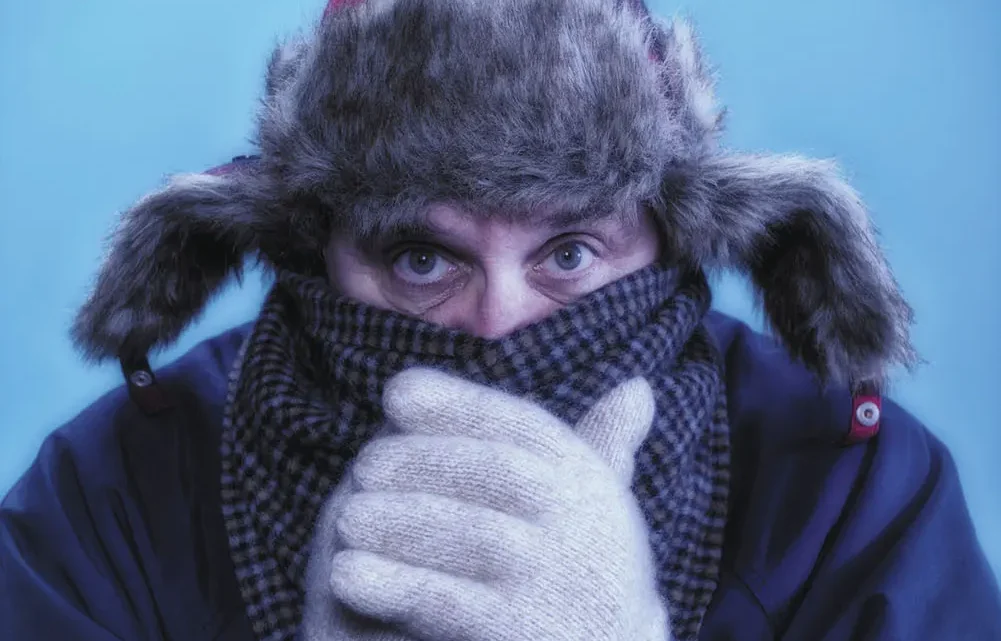
The Science of Why Some People Are Always Cold
Muscle mass, hormones, and a little-known tissue called brown fat explain why some people never seem to warm up, and when persistent cold actually signals something medical.
The hypothalamus, a small region at the base of the brain, runs a constant negotiation between heat production and heat loss to keep core temperature near 37 degrees Celsius.
When it senses cold, it triggers shivering, tightens blood vessels in the extremities, and slows blood flow to the skin so warmth stays concentrated around vital organs.
Trending Now!!:
This process, thermoregulation, functions the same way in nearly everyone. What differs, sometimes dramatically, is the raw material each person’s body has to work with: how much muscle they carry, how their blood vessels react, and how efficiently their hormones run the operation.
That distinction matters because it separates two very different groups of people. Some individuals have a core body temperature that runs significantly lower than average, which is rare and usually associated with a medical condition.
Far more common are people whose core temperature is normal, but whose bodies are unusually quick to signal cold and unusually aggressive about conserving it. The second group experiences the same subjective misery without anything showing up as abnormal on a basic checkup, which is precisely why so many people who complain of chronic cold get told everything looks fine.
Muscle Mass Does More Work Than People Assume
Skeletal muscle is metabolically active tissue. It continuously generates heat through baseline metabolic activity, even during periods of complete rest, contributing a substantial share of resting heat production.




Research on sarcopenia, the age-related loss of muscle mass, has documented measurable consequences for thermoregulation in older adults, whose reduced muscle mass leads them to produce less ambient body heat and respond more slowly to cold stress.
This is a point that gets flattened in most consumer health coverage, which tends to frame “always cold” purely as a circulation problem. Muscle mass relative to body surface area is often the more decisive variable. A person with a lean, low-muscle frame has more skin surface through which to lose heat and less internal furnace to replace it.
Christopher Minson, a human physiology researcher at the University of Oregon who studies thermoregulation, has described this as the core mechanism behind chronic cold sensitivity: people who run cold typically have lower muscle mass relative to their body surface area, a pattern that appears disproportionately in women and older adults.
Their core temperature is frequently normal. What differs is how aggressively the body vasoconstricts to defend that core, which produces the sensation of cold in the hands, feet, and skin well before anything is actually wrong internally.
This explains a familiar domestic friction point: one partner reaching for the thermostat while the other is comfortable in a t-shirt. It is rarely a matter of one person being dramatic.
Lower muscle-to-surface-area ratios, more common in women, mean the body diverts blood away from the extremities faster and more forcefully to protect the core, leaving hands and feet cold even in a room that objectively is not.
Sex Differences Go Deeper Than Muscle Mass
Beyond body composition, there is growing evidence of a genuine hormonal layer to cold sensitivity in women.
A crossover study led by Mariëtte Boon, an endocrinology researcher whose findings on brown fat activity have been widely cited in metabolic research, found that women begin shivering at meaningfully lower skin temperatures than men, a difference that shows up independent of muscle mass or body fat percentage.
Reviews of brown adipose tissue research have similarly found that in animal models, females activate thermogenesis earlier when temperatures drop, and while human data is less consistent, several studies point in the same direction.
The menstrual cycle adds another layer that rarely comes up in mainstream advice. Basal body temperature fluctuates across the cycle, typically by roughly half a degree Fahrenheit, dipping just before ovulation when estrogen rises without progesterone to balance it, then climbing during the second half of the cycle once both hormones are elevated.
This is not incidental; it reflects a genuine shift in the hypothalamus’s thermoregulatory set point. Women approaching or going through menopause, when estrogen production declines, often report more pronounced and less predictable swings between feeling cold and feeling flushed, a pattern connected to the same hormonal machinery that governs hot flashes.
Brown Fat: The Tissue Most People Have Never Heard Of
Brown adipose tissue, or brown fat, is functionally distinct from the white fat most people associate with body weight. Rather than storing energy, brown fat burns it to generate heat directly, a process called non-shivering thermogenesis.
It was long assumed to matter only in infants, who lack the muscle mass to shiver effectively, but PET-CT imaging studies published in The New England Journal of Medicine confirmed measurable amounts of active brown fat in healthy adults, concentrated in deposits around the neck and upper back.
People vary substantially in how much active brown fat they carry, and that variation appears to decline with age and rise with body fat percentage in a way that is not fully understood. Cold acclimation studies have shown that repeated, deliberate cold exposure can increase both the volume and activity of brown fat over several weeks, which is part of the rationale behind cold-exposure practices like ice baths and cold showers that have gained popularity as recovery tools.
The effect is real but modest, and researchers studying the tissue have cautioned against overstating its impact on broader metabolic health; its primary, well-established role remains heat generation rather than a meaningful lever for blood sugar or weight control.
When Cold Sensitivity Signals Something Medical
Persistent cold intolerance sometimes does point to an underlying condition, and distinguishing ordinary cold sensitivity from a medical issue is where a lot of self-diagnosis goes wrong.
Iron-deficiency anemia is among the most common culprits. Red blood cells carry oxygen that fuels heat production throughout the body, and when iron levels drop, the body has less capacity to generate that heat and often redirects circulation away from the extremities to preserve it. Anemia-related cold sensitivity often accompanies fatigue, pale skin, and shortness of breath with exertion, and it warrants bloodwork rather than more blankets.
Hypothyroidism, an underactive thyroid, slows metabolism across the board. Thyroid hormone governs the rate at which cells burn energy, and research on thermogenesis has confirmed its direct role in activating heat-producing pathways in adipose tissue. When thyroid output falls, metabolic rate falls with it, and a lower resting metabolism means less baseline heat production.
This is one of the more overlooked causes precisely because its other symptoms, fatigue, weight gain, dry skin, develop gradually and get attributed to stress or aging long before anyone checks thyroid-stimulating hormone levels.
Raynaud’s phenomenon is a more specific circulatory condition in which small blood vessels in the fingers and toes overreact to cold or stress, constricting sharply enough to cause visible colour changes, from white to blue to red, along with numbness or pain.
Clinical reviews describe it as distinct from ordinary cold hands: Raynaud’s episodes are triggered suddenly, often by minor temperature drops or emotional stress, and resolve once circulation returns, rather than representing a constant baseline chill.
Occupational medicine research has also identified cold sensitivity as an occupational health marker, with a large Swedish case-control study finding associations between cold sensitivity and factors such as smoking, certain repetitive hand work, and prior cold injury, a reminder that lifestyle and exposure history matter alongside genetics.
The Genetics Angle Is Real but Overstated in Places
A newer thread of research has looked at genetic variants tied to thermoregulation, including genes involved in brown fat activation, thyroid hormone conversion, vitamin D signalling, and cold-sensing receptors in the skin.
This is legitimate biology: variation in genes like those governing brown fat thermogenesis and cold-sensitive nerve receptors plausibly explains why some people run cold despite normal bloodwork and healthy body composition.
Where this research gets oversold is in direct-to-consumer genetic testing marketed as a definitive explanation and fix for cold intolerance. Genetic predisposition is one layer among several, not a standalone diagnosis, and it should not replace a basic medical workup for anemia and thyroid function, which remain far more common and far more treatable causes.
Common Mistakes People Make
A frequent misconception is that feeling cold necessarily means core body temperature is abnormally low. In most healthy people who run cold, core temperature is entirely normal; the sensation comes from the body’s decision to divert blood away from the skin, not from an actual temperature deficit.
Another common error is assuming that eating more or bundling up more heavily addresses the root cause. Chronic dieting or inadequate caloric intake genuinely does worsen cold sensitivity by reducing the fuel available for heat production, but for most people with an already adequate diet, the fix lies in circulation and muscle mass, not additional calories.
A third misconception treats cold sensitivity purely as a women’s issue tied to smaller body size. While body composition differences do explain much of the gender gap, hormonal cycling, thyroid conditions, and vascular reactivity are independent contributors that affect men as well.
Practical Steps That Actually Change the Physiology
Building muscle mass through resistance training addresses the problem at its structural root, since more muscle tissue means more baseline heat production around the clock, not just during exercise.
Regular movement throughout the day, rather than long bouts of sedentary time punctuated by a single workout, keeps blood circulating to the extremities more consistently. Deliberate, gradual cold exposure, of the kind used in brown fat acclimation research, can modestly increase thermogenic capacity over weeks, though it is not a fast fix and is not appropriate for anyone with cardiovascular conditions without medical guidance.
For anyone whose cold sensitivity is sudden in onset, disproportionate, or accompanied by fatigue, hair thinning, unexplained weight change, or numbness and colour changes in the fingers, bloodwork covering iron levels and thyroid function is the appropriate next step rather than another layer of clothing.
The Bottom Line
Chronic cold sensitivity is rarely mysterious once it is broken down. Muscle mass, sex-linked differences in vascular response and brown fat activity, hormonal cycling, and a short list of treatable medical conditions account for the overwhelming majority of cases.
The people who run cold are not imagining it, and in most instances their bodies are working exactly as designed, just defending a normal core temperature more aggressively than everyone else’s.
What People Ask