My Best Friend Hid Her Breakup From Me for Three Weeks. I Finally Understood Why
Mateo was halfway across Avenida 18 de Julio when his phone rang for the sixth time that morning, and he knew from the name on the screen that he should not answer it.
It was Lucía.
Trending Now!!:
He stopped anyway.
Are you near Tres Cruces?
He looked up at the buses rolling past, checked the time, then typed back.
Why?




The three dots appeared almost at once.
Because I need a favor.
That was how it always started with Lucía.
Not with hello. Not with how are you. Just a favor, usually delivered with the confidence of someone who already knew the answer would be yes.
The strange thing was that Mateo had stopped being angry about it months ago. He had tried anger. He had tried ignoring messages. He had even muted her chat on WhatsApp, which lasted exactly nine days before curiosity got the better of him.
Now he was standing outside a pharmacy near the corner of 18 de Julio and Ejido, watching people hurry toward offices and university buildings, wondering why his oldest friend had suddenly remembered he existed.
He typed again.
What kind of favor?
Her reply came back.
Can you come to my apartment?
No explanation.
No emoji.
That was unusual.
Mateo put his phone in his pocket and sighed.
Fine.
He took the next bus toward Parque Rodó.
Montevideo had that particular gray morning light that made everything look slightly unfinished. The sidewalks were damp from rain that had stopped before sunrise. Someone had left a paper coffee cup on a wall. A dog in a red sweater pulled its owner toward a bakery, while a delivery cyclist shouted at a taxi that had stopped in the bike lane.
Normal morning.
That was what Mateo liked about the city. Even when his own life felt completely upside down, Montevideo kept behaving as if nothing important had happened.
When he reached Lucía’s apartment, she opened the door before he knocked twice.
She looked terrible.
Not dramatically terrible. That would have been easier.
Her hair was tied up badly. She wore an old Peñarol sweatshirt and one sock. There was a bowl of cereal on the kitchen table that had clearly been sitting there for hours.
Mateo looked at her.
You look awful.
She nodded.
I know.
Did you sleep?
No.
Did you eat?
She looked at the cereal.
Technically.
He walked inside.
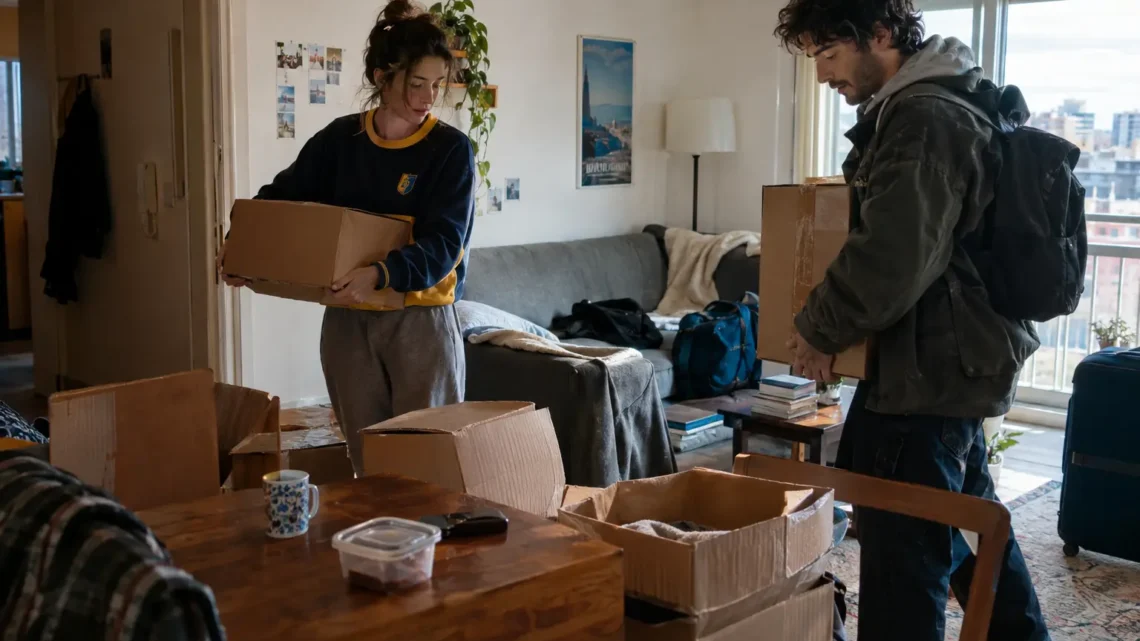
The apartment smelled like coffee and wet clothes. On the sofa were three cardboard boxes, a half-packed suitcase, and a pile of clothes that looked like they had been thrown there rather than folded.
Mateo stared at the boxes.
Are you moving?
Lucía shook her head.
Not exactly.
That sounds encouraging.
She sat down.
For a few seconds, neither of them said anything.
Then she pointed at the boxes.
I need you to help me take those to my mother’s house.
Mateo laughed once.
That is the favor?
Yes.
You made me cross half the city for boxes?
I didn’t make you.
You said you needed me.
I do.
That stopped him.
Mateo had known Lucía since they were fourteen. They had met outside their secondary school after she borrowed his pen and forgot to return it. Years later, she still had that pen.
He had asked for it back once.
She had laughed.
Then she had changed the subject.
They had grown up together without ever really admitting that was what they were doing. First exams, then university applications, terrible first jobs, birthdays, breakups, family arguments, cheap dinners, expensive mistakes.
At twenty-nine, they had somehow become adults while still feeling like two teenagers who were improvising everything.
The boxes were heavier than they looked.
They carried them down three flights of stairs because the elevator was broken again. On the second floor, Mateo nearly dropped one when a neighbor opened her door at exactly the wrong moment.
Careful, muchacho.
I’m trying.
You two moving?
Lucía answered before Mateo could.
No.
The neighbor looked at the boxes.
Then at them.
Then back at the boxes.
Okay.
She closed her door.
Outside, Mateo started laughing.
Lucía looked annoyed.
What?
Nothing.
You’re laughing.
Because you just lied to an old woman about moving.
We’re not moving.
You packed your whole life into six boxes.
She looked down.
Not my whole life.
They walked toward the taxi stand.
Halfway there, Lucía said something that made Mateo stop.
I broke up with Santiago.
He stared at her.
When?
Three weeks ago.
Three weeks?
She nodded.
You didn’t tell me.
I know.
That hurt more than he expected.
For the first time that morning, Mateo understood the boxes.
They were not moving.
She was removing Santiago’s things from her apartment because she could not bear looking at them anymore.
The blue mug he used every morning.
The books he left on the shelf.
The old football scarf hanging behind the bedroom door.
The cheap speaker he had bought online.
Small things. Stupid things.
The kind of things that made a breakup feel less like losing a person and more like discovering how much space one person had occupied without you noticing.
They loaded everything into a taxi.
During the drive, Lucía stared out the window.
Mateo wanted to ask what had happened.
He didn’t.
She eventually spoke.
He said I was his best friend.
Mateo waited.
Then he said he needed to be with someone who understood him.
That sounds bad.
It was worse.
She smiled without looking at him.
The someone was already at his office.
Mateo leaned back.
Oh.
Exactly.
The taxi stopped at a red light near Bulevar España.
Outside, a man walked past carrying flowers. Two teenagers shared earphones while waiting for the crossing signal. A woman stood under an awning scrolling through Instagram, completely absorbed in whatever was happening on her screen.
Normal life.
Again.
Lucía rubbed her hands together.
I haven’t told my mother.
Why not?
Because she’ll ask if I’m okay.
She probably means well.
I know.
Then what’s the problem?
Lucía looked at him.
I don’t know what to say.
Mateo understood that.
Sometimes saying I am not okay made the thing real.
They reached her mother’s house around noon.
The boxes went into the spare bedroom.
Her mother was not home.
That was probably why Lucía had chosen that day.
Afterward, they sat on the kitchen floor and ate empanadas from a paper bag because neither of them had the energy to cook.
Mateo gave her the last one.
She pushed it back.
You take it.
I’m full.
You’re never full.
I’m emotionally full.
She laughed.
It was the first real laugh he had heard from her all day.
Then her phone buzzed.
She looked at the screen.
Her face changed.
Mateo noticed.
Him?
She nodded.
It was Santiago.
He had sent a message.
Can we talk?
Lucía showed it to Mateo.
He looked at her.
Do you want to?
I don’t know.
Then don’t answer yet.
She stared at the message.
What if I regret not answering?
You might.
What if I regret answering?
You might.
She looked at him.
That is terrible advice.
It’s honest advice.
She smiled.
Then she typed something.
Mateo did not ask what.
A few seconds later, she put the phone face down.
They sat quietly.
After a while, Lucía said, You know what bothers me?
What?
You were the person I wanted to call.
Mateo looked at her.
She continued.
Not because you could fix it. You can’t. I just knew you would come.
He looked at the empty empanada bag.
There were probably a hundred things he could have said.
Instead, he said, You should still give me more notice.
She laughed again.
Fair.
They stayed until the afternoon.
Before Mateo left, Lucía handed him a small plastic bag.
What’s this?
Your pen.
He opened it.
The old blue pen was inside.
He recognized it immediately.
Fourteen years.
She had kept it for fourteen years.
He looked at her.
You still had this?
I told you I didn’t lose it.
You told me that when we were fourteen.
Exactly.
He held the pen between his fingers.
There was something almost embarrassing about how much it meant to him.
Not because it was valuable.
It wasn’t.
The cap was cracked. The ink was probably dry. The logo had faded.
It was just a pen.
Still, it was proof that some things survived mostly because nobody had bothered to throw them away.
When Mateo reached the street, his phone buzzed.
A message from Lucía.
Thank you for coming.
He smiled.
Then another message appeared.
Also, I lied.
He stopped walking.
About what?
The typing dots appeared.
Disappeared.
Appeared again.
Then nothing.
Mateo waited.
One minute.
Two.
Five.
Finally, he put the phone away and kept walking toward Bulevar España.
He never found out what she had meant that afternoon.
At least not then.
The next morning, he used the old pen to sign a receipt at work.
It still worked.
Barely.
Sometimes the things we think are finished are only waiting for someone to pick them up again.