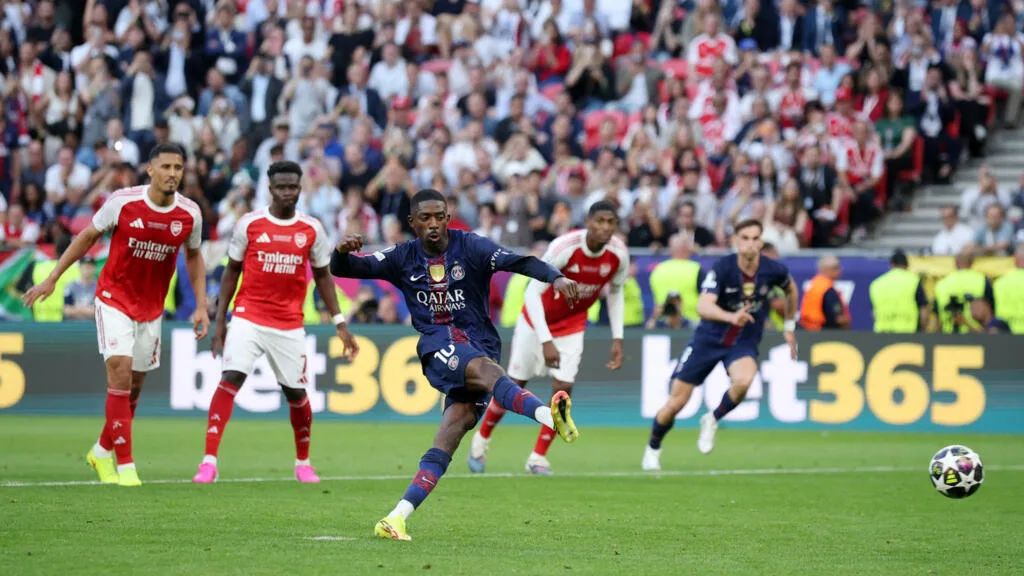
Why Arsenal’s UCL Final Performance Was Everything Wrong With Mikel Arteta’s Football
A Champions League final is not a siege operation. Someone forgot to tell Arsenal.
Budapest was supposed to be the night. One hundred and forty years of Arsenal Football Club. It has been twenty years since Thierry Henry and Robert Pires stood in Paris and still went home empty-handed.
Trending Now!!:
The Premier League title was already wrapped up. All they needed was ninety minutes, or so the faithful told themselves.
What they got instead was a masterclass in how to build a fortress, forget to bring a cannon, and then hand the keys over at a penalty shootout.
Mikel Arteta’s Arsenal lost to Paris Saint-Germain 4-3 on penalties after a 1-1 draw across 120 minutes at the Puskás Aréna. On the surface, it was heartbreak. Underneath, it was entirely predictable. And if you watched the match with any objectivity stripped of red-and-white sentiment, it was a damning portrait of a side that has confused defensive industry with football quality.
Arsenal went ahead after six minutes when a midfield clearance attempt by Marquinhos deflected off Leandro Trossard and sent Kai Havertz streaking down the left flank. Havertz, who has an extraordinary habit of scoring in Champions League finals dating back to his Chelsea days, took three dribbles and produced a masterful finish to put the Gunners in dreamland.


But be honest about how that goal came about. There was more than a hint of fortune in the way the ball broke for Havertz after Marquinhos’ attempted clearance smashed into Leandro Trossard’s left shoulder. Arsenal did not engineer that chance. The ball simply fell their way, Havertz did what he is technically capable of doing, and the scoreboard said 1-0. Cue the celebrations. Cue the plans.
What followed was not a plan to win a football match. What followed was a plan to survive one.
The statistics from this final should be tattooed on the forehead of every person who describes Arteta’s Arsenal as a good football team. PSG controlled 75.3% of the ball to Arsenal’s 24.7%. They registered 21 shot attempts to Arsenal’s seven, with four shots on goal to Arsenal’s one. PSG had 11 corners. Arsenal had four.
Read that again. In a Champions League final, with a one-goal lead, Arsenal produced a single shot on target in 120 minutes of football. One. That is not tactical discipline. That is not elite defending at its peak. That is a team that has no functional idea what to do with a lead except protect it, wait, and pray.
If we’re being honest, Arsenal played this one about right. Once they got the lucky break and brilliant early goal from Havertz, the plan was clearly to eat up as much of the clock as possible and force PSG to burn as much energy as possible to even the match. The more open the match was, the worse it was likely to work out for them.
That quote, from ESPN’s own analysis, is not a compliment. It is an admission that Arsenal’s ceiling in this competition was to nick a goal, drop deep, and survive. Against a PSG side packed with Ousmane Dembélé, Khvicha Kvaratskhelia, João Neves, and Vitinha, surviving is not a philosophy. It is a prayer dressed up as a gameplan.
Arteta chose Havertz as the lone striker over Viktor Gyökeres, the marquee summer signing brought in specifically to lead Arsenal’s line in moments like this. Havertz vindicated Arteta’s decision to pick him ahead of the marquee summer signing only in the sense that he scored. But for 114 of the 120 minutes, Arsenal had no one pressing, no one holding up play, no outlet, no threat. The front line was invisible.
The midfield selection told a similar story. Arteta made the transition from possession-oriented, attack-minded football to what they became this year: a unit that is more physical, more compact and more risk-averse, one that relies less on taking the game to the opposition and more on punishing errors, individual moments, and set-pieces. Against PSG, there were no errors to punish after the opening six minutes. And when you have used every ounce of your structure to defend, you have nothing left when you actually need a goal.
Vitinha finished the game with the most touches of any player at 162, the most pass completions at 141, the most passes received at 127, the most carries at 133, a carry distance of 671 metres, and 22 progressive carries. He ran this game from the first whistle to the last. Arsenal had no answer for him. They had no one capable of matching his tempo, his range, his ability to shift the ball in tight spaces and find the third man.
Arsenal held their lead deep into the second half. Then Cristhian Mosquera, the defender brought in to add defensive cover, fouled Khvicha Kvaratskhelia, catching him on the calf as the Georgian broke forward, and Dembélé stepped up and converted with the casual authority of a man who has been doing this all season. Equaliser. 1-1. Game reset.
That foul was not a fluke. It was the direct consequence of a side defending with the intensity of a team that knows it cannot score again, one that puts its body on the line so repeatedly that concentration eventually slips.
Arsenal were outstanding defensively for long stretches. Gabriel put his body on the line to keep PSG at bay across 120 minutes, and David Raya was excellent. Myles Lewis-Skelly wonderfully intervened when Kvaratskhelia had Raya’s goal in sight, sending the Georgian’s strike onto the post after William Saliba had misjudged a long ball over the top.
But that is the point. Arsenal’s best moments in this final were defensive interventions. Not passes. Not combinations. Not forward runs. Blocks, clearances, and a midfielder tracking back to save a goalkeeper he should not have had to.
PSG landed the first psychological blow of the penalty shootout when they won the coin toss, with the shootout taking place in front of their supporters. From there, Arsenal’s fragility in high-pressure moments was exposed mercilessly.
Eberechi Eze dragged his spot-kick wide. Raya provided Arsenal with a lifeline when he saved from Nuno Mendes. With the shootout in the balance at 3-3, Lucas Beraldo sent Raya the wrong way before Gabriel Magalhães blazed over the crossbar. Gabriel, arguably Arsenal’s best player on the night after he put his body on the line to keep PSG at bay across 120 minutes, responded by lifting his shirt over his face as his teammates attempted to console the agonised defender.
Nobody should blame Gabriel for that penalty. But somebody should ask why a centre-back was stepping up in the decisive moment of a Champions League final, and why Bukayo Saka, arguably Arsenal’s most technically gifted player, was not visible in the penalty order. And why Gyökeres, brought in for exactly these high-stakes contributions, apparently had no role to play at any point in 120 minutes of a final.
The possession problem is not new, and Emmanuel Petit said it best. Petit has been direct about Arsenal’s approach under Arteta: “Possession is good, but if you don’t play forward football, possession can be boring. Give me the ball, I give you the ball, give me the ball, I give you the ball.”
He praised PSG’s evolution under Luis Enrique, highlighting their switch from sterile control to fast, forward-thinking football, and suggested Arsenal need to embrace a similar attacking intent if they want to take the next step.
Petit played for Arsenal. He knows what exciting, purposeful football from that club looks like. What he watched in Budapest was not that. It was a team structurally allergic to risk, convinced that defensive organisation is a sufficient answer to the best football being played in Europe right now.
PSG are not just well-organised. They move. They press. They transition with terrifying speed. Dembélé and Kvaratskhelia on the flanks represent the most exciting wide partnership in the world right now, and Arsenal’s answer to both of them was to pack the defensive block and hope the clock ran out. It did not run out. It never does against teams this good.
Despite the intensity of the final moments of normal time, Arsenal hung on. The almost insatiable appetite they have to defend is truly admirable. It has taken them to the Premier League title and just yards away from a first Champions League.
That is the charitable reading. The less charitable one is that a team which wins the Premier League by playing one style of football, then arrives at a Champions League final and decides its only viable approach is to park the bus after a deflected sixth-minute goal, is not a complete football team. It is half a team with an excellent second half.
Arteta has done brilliant work in north London. The Premier League title is real. The development of Saka, Declan Rice, and Lewis-Skelly into elite players is real. But there is a ceiling on this style in European football, and that ceiling was on full display in Budapest.
Arsenal’s bid to win the Champions League for the first time in their 140-year history ended in heartbreak. It ended not because of bad luck. It ended because the plan ran out at 65 minutes, and everything after that was survival football with nothing in reserve.
A Champions League final is not the place for 24% possession. It is not the place for one shot on target in 120 minutes. It is not the place for a centre-back to carry the decisive penalty kick on his shoulders while a marquee striker watches from the bench. Arsenal were admirable.
They were resilient. They were brave. They were also, in the most honest assessment, not good enough on the ball to belong in a final against PSG. Not because of quality in isolation but because of identity. A team that has made its name suffocating opposition, grinding results, and converting set-pieces will always be one bad bounce from extinction in a match where the other team controls everything except the scoreboard.
Luis Enrique’s side are back-to-back Champions League winners. When they write the story of the greatest teams to ever grace the European club game, they will put this PSG side firmly in that conversation.
Arsenal need to have an honest conversation about what they want to be. Because the answer right now is a very good defensive unit that got extraordinarily far on a fluke goal and extraordinary willpower. That is not the foundation for a Champions League-winning side. That is the foundation for another heartbreak in another final, in another city, in another year. And the clock is ticking.