World Cup 2026: Top 20 Stars So Far, as France Become First Team to Reach Semi-Finals
France have booked the first semi-final berth of the 2026 World Cup, beating Morocco 2-0 in Boston to become the tournament’s first confirmed last-four side.
Kylian Mbappé and Ousmane Dembélé scored the goals that sent Les Bleus through to a third straight semi-final, extending a run that has made them the only unbeaten team yet to require extra time this summer.
Trending Now!!:
That result reshapes the conversation heading into the closing stages of the competition, and it is a natural point to take stock of who has actually driven this tournament. Individual brilliance and team success rarely align perfectly at a World Cup, and 2026 has been no exception.
What follows is a ranking of the 20 players who have most defined the tournament through the quarter-final stage, built on goal contributions, tactical influence, and the weight each performance has carried within its team’s run.
Why France’s Semi-Final Berth Matters for the Broader Storyline
Didier Deschamps’ side reaching the last four before any other nation is not simply a scheduling quirk. France remained perfect on the tournament and became the only team to win all six of its matches without needing extra time after the win over Morocco.
That level of control, playing through a knockout bracket that has already claimed Brazil, Germany, Portugal and the United States, is precisely the kind of context that separates a good tournament from a legacy-defining one.


Mbappé curled in his eighth goal of the tournament before Dembélé added a second to seal a clinical victory against a Moroccan side that had been tipped to cause serious problems. The win sent Deschamps’ side to a third consecutive World Cup semi-final, a level of sustained excellence that has no modern parallel outside of Brazil’s mid-20th-century dynasty and Germany’s 2002-2014 stretch.
France now wait for the winner of Friday’s quarter-final between Spain and Belgium, with the semi-final scheduled for Arlington, Texas.
The Top 20 Stars of the 2026 World Cup, Ranked
1. Kylian Mbappé (France)
Kylian Mbappé has been the most complete forward at the tournament, combining goal output with creative responsibility. He is currently tied with Lionel Messi at the top of the Golden Boot standings with eight goals each, and holds the tiebreaker advantage with two assists compared to none for Messi.
What separates Mbappé from the chasing pack is not just the scoring, but the fact he is doing it as the focal point of the tournament’s most balanced attack. He has scored in all but one of France’s five games at the World Cup, often netting twice.
Should he finish top scorer, he becomes the first man in tournament history to win the Golden Boot in consecutive editions, a distinction that eluded Ronaldo, Thomas Müller and Just Fontaine alike.
2. Lionel Messi (Argentina)
Lionel Messi’s tournament has already secured its place in the history books regardless of what happens next. He became the all-time leading scorer in men’s World Cup history during the group stage, and added further goals against Jordan, Cabo Verde and Egypt to push his career tally higher.
At 39, in what is widely presumed to be his final World Cup, Messi has not simply been a symbolic presence; two of his goals against Algeria came from him receiving the ball at the top of the box and finishing with venom, the same movement patterns that have defined his career for two decades.
The one prize that has escaped him is the Golden Boot itself, and that chase remains the most compelling individual subplot left in the tournament.
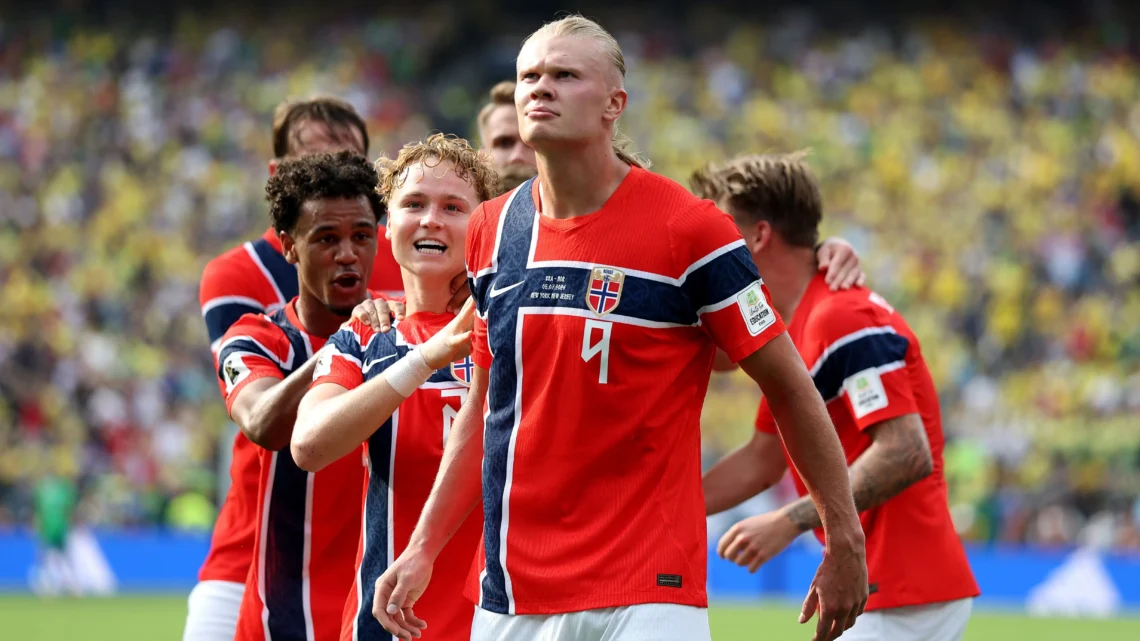
3. Erling Haaland (Norway)
Erling Haaland has dragged an above-average Norwegian side deep into the tournament almost single-handedly.
The 25-year-old has scored seven goals in four games in North America, including a crucial brace in the round of 16 against Brazil. His self-assessment after the Senegal group match, that scoring goals is simply “his specialty”, reads less like bravado and more like a plain statement of fact given the underlying numbers.
Norway’s ceiling depends entirely on how far his finishing can carry a team that is otherwise solid rather than spectacular.
4. Ousmane Dembélé (France)
Ousmane Dembélé’s tournament arc has mirrored his Ballon d’Or-winning club season at Paris Saint-Germain: understated for long stretches, then suddenly decisive. He struck three times in a first-half hat-trick against Norway before adding a fifth goal, the vital strike that sealed the 2-0 win over Morocco in the quarter-final.
What the raw numbers undersell is his role off the ball. A separate statistical ranking of the tournament’s standout performers noted that Dembélé has not been the headline act for France in terms of pure output, which speaks to the depth of attacking talent Deschamps has at his disposal, yet he remains a persistent nightmare for opposition defenses.
That combination of end product and disruptive movement is exactly what elite tournament forwards provide.
5. Harry Kane (England)
Harry Kane has quietly assembled one of the most efficient scoring runs of his international career at precisely the right moment.
He overtook Gary Lineker to become England’s all-time leading marksman at World Cup finals with a header against Panama, then added two more in a comeback win over DR Congo, before holding his nerve to convert a penalty in a chaotic 3-2 win over Mexico.
Four goals from the penalty spot or in broken-play situations across a tournament is not luck; it reflects a striker whose positional intelligence has matured even as his athleticism has declined slightly from his peak years at Tottenham and Bayern Munich.
6. Rodri (Spain)
Individual brilliance in modern tournament football increasingly hides in midfield rather than in front of goal, and Rodri is the clearest example of that at this World Cup.
The reigning Ballon d’Or winner has been a rock in the middle of the park for Spain’s run to the quarter-finals, and after suffering injuries in recent seasons, he is now showing the same form that earned him the individual award in 2024. Spain’s structural control of games, evident even in the tighter win over Portugal, traces directly back to his positioning.
7. Mikel Oyarzabal (Spain)
Mikel Oyarzabal has been the most efficient finisher in Spain’s squad.
He has scored four goals with an assist through five matches, numbers that place him firmly inside the Golden Boot conversation, and his link-up play with Lamine Yamal and Rodri has given La Roja a more direct edge than the possession-heavy sides of the 2010 and 2012 generation.
8. Vinícius Júnior (Brazil)
Brazil’s exit does not erase what Vinícius Júnior produced before it. He scored with a stunning effort in the opener against Morocco, then added a second in a commanding win over Haiti, before taking his tally to four goals in a 3-0 win over Scotland.
A separate statistical model of the tournament’s best individual performers, based on average match ratings, placed him fifth overall despite Brazil’s early departure, a reminder that raw output and match-winning influence do not always determine how far a team travels.
9. Ismaïla Sarr (Senegal)
Ismaïla Sarr’s tournament has been one of the more pleasant surprises among the non-traditional powers.
He hit the back of the net four times across Senegal’s run to the last 32, a tally that matches players from significantly more storied footballing nations and underlines how much scouting departments across Europe will be revisiting his Marseille tape this autumn.
10. Aurélien Tchouaméni (France)
France’s forward line draws the headlines, but Aurélien Tchouaméni has been the reason the team rarely looks disorganized in transition. He is controlling proceedings for France in their dominant outings so far, and it is easy to understand why Manchester United have been linked with a move for him.
His reading of second balls and willingness to break up counters before they develop has been central to France conceding so little across six matches.
11. Lamine Yamal (Spain)
Lamine Yamal entered the tournament under an injury cloud and has answered every question about his fitness with performances that belong to a player well beyond his years.
His confidence off the pitch matches his output on it; he insisted last month that “France is not better than Spain”, adding pointedly that Les Bleus had not beaten Spain since Euro 2024. Should Spain get past Belgium and set up a semi-final rematch with France, that claim will be tested in the most public way possible.
12. Jude Bellingham (England)
Jude Bellingham has not dominated a single England match the way he did at times during Euro 2024, but his consistency has been the connective tissue of a Three Lions side built around Kane’s finishing.
He has scored two goals through the knockout rounds, and his box-to-box energy has repeatedly bailed England out of moments where their build-up play stalled.
13. Désiré Doué (France)
Désiré Doué’s emergence as a genuine attacking threat, rather than a squad rotation option, has given Deschamps a fourth forward-line weapon alongside Mbappé, Dembélé and Olise. That depth is precisely why opposition managers have struggled to game-plan around stopping any single French player.
14. Michael Olise (France)
Michael Olise’s set-piece delivery and right-wing directness have added a different dimension to France’s attack compared to the pace-and-power profile of Mbappé and Dembélé.
France have 13 players from pre-tournament top-100 rankings still in action, more than any other remaining nation, and Olise’s improvement over the past twelve months is a large part of why that squad depth translates into genuine tactical flexibility rather than just star power.
15. Cristiano Ronaldo (Portugal)
Cristiano Ronaldo’s international career ended in the round of 16, but not before he added another chapter to an already unmatched World Cup legacy. He scored three goals across the group stage and knockout rounds, including two in a 5-0 win over Uzbekistan.
He remains the only player to score at six different World Cups, and only eight players in history have scored more than his career total in the competition. That the trophy itself eluded him again will remain the defining asterisk on an otherwise historic body of work.
16. Deniz Undav (Germany)
Germany’s tournament ended earlier than expected, but Deniz Undav’s finishing was one of the few genuine positives.
His strike rate for Germany has been remarkable, netting nine international goals in just thirteen appearances, and he stepped off the bench repeatedly at this World Cup to score in a 7-1 win over Curacao before adding a match-winning brace against Ivory Coast. Super-sub roles rarely earn this much individual credit, but Undav’s impact was too decisive to ignore.
17. Jonathan David (Canada)
Jonathan David’s club season at Juventus had been forgettable by his own standards, which made his tournament form all the more striking.
He scored a hat-trick against Qatar, single-handedly proving that international tournaments can still reset a player’s momentum in ways a difficult league campaign cannot.
18. Mike Maignan (France)
Goalkeeping rarely gets the credit it deserves in rankings built around attacking output, but Mike Maignan’s calm authority behind France’s back line has been essential to the team conceding so little.
His first and only save of the entire quarter-final against Morocco did not come until the 83rd minute, a statistic that speaks to defensive organization as much as individual shot-stopping, though the save itself, on a dangerous late chance with the tie still technically alive, was the difference between a comfortable win and a nervy finish.
19. Elliot Anderson (England)
Few players have used this tournament as a launchpad the way Elliot Anderson has. The England midfielder posted an average match rating of 7.39 through the knockout rounds, kicking off a wider list of the tournament’s standout statistical performers, a remarkable showing for a player enjoying his first major international tournament while adjusting to a big-money move to Manchester City.
20. Yassine Bounou (Morocco)
Morocco’s elimination should not obscure how good their goalkeeper was throughout the tournament. Yassine Bounou made six saves in the quarter-final defeat to France, including an outstanding leaning save to deny Jean-Philippe Mateta with his side sitting two minutes from elimination.
His performances across the tournament were a significant part of why Morocco went as far as they did as the last remaining African representative.
What the List Reveals About This World Cup
A few patterns stand out beyond the individual entries. France’s presence at four spots in the top 20, and 13 inside the pre-tournament top 100 still active heading into the semi-finals, is not an accident of scheduling.
It reflects a squad built with enough attacking and midfield depth that no single injury or suspension threatens the entire structure, which is precisely the profile that tends to win tournaments rather than simply reach the latter stages of them.
The Golden Boot race also illustrates something worth understanding for anyone following the closing weeks: individual scoring titles and team success are correlated but not identical.
Historically, the Golden Boot winner tends to come from a team that reaches at least the semi-finals, and with Mbappé, Messi and Haaland all still separated by fractions of a tiebreaker, the outcome may hinge as much on how many knockout matches each player’s team survives as on finishing ability alone.
Finally, the presence of players from eliminated sides such as Ronaldo, Vinícius, Bounou and Undav on this list is a deliberate choice.
Ranking exclusively by trophies remaining ignores the reality that a World Cup produces individual performances that shape transfer windows, sponsorship value and historical legacy independent of who ultimately lifts the trophy on July 19 at MetLife Stadium.