
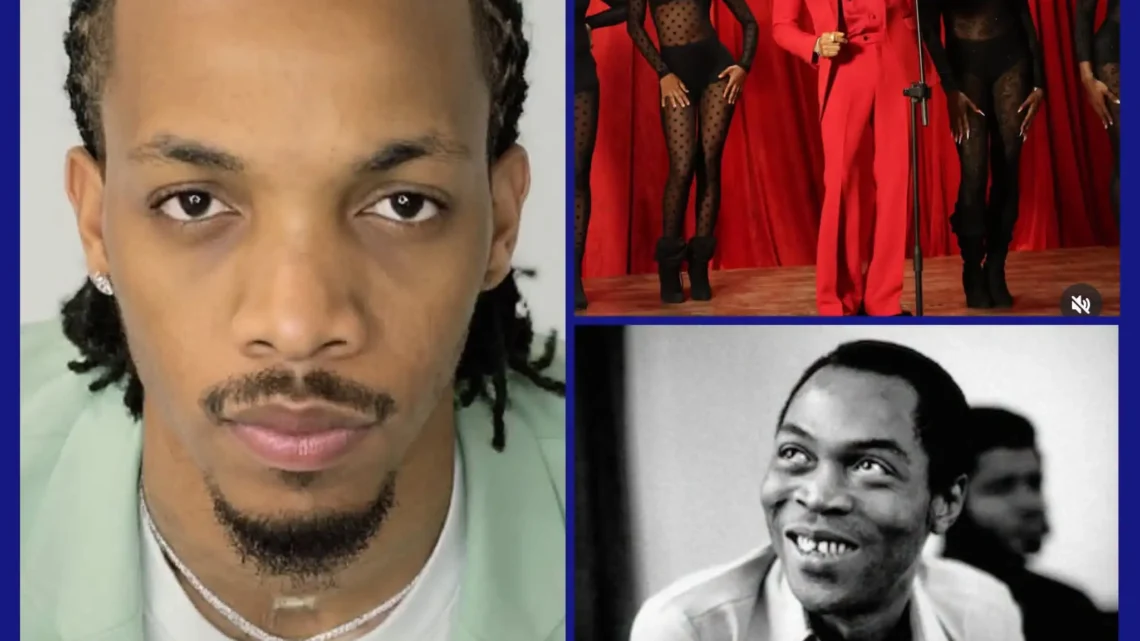
Tekno Says Fela Didn’t Invent Afrobeat. Nigeria Isn’t Taking It Well
Alhaji Tekno’s remark on Fela Kuti was not the story he ended up making. Within a day, the Nigerian singer had put himself in the middle of one of the country’s oldest cultural fault lines, between Southwest and Southeast, Yoruba and Igbo, over who actually shaped the sound of Nigerian music.
Tekno, born Augustine Miles Kelechi Okechukwu in Bauchi State to a family with roots in Ivo, Ebonyi State, made the comments during an interview on New York radio station HOT 97. Asked about Fela Kuti’s legacy, he pushed back on the idea that any one person should be credited as the inventor of Afrobeat.
Trending Now!!:
“Fela is not the originator of Afrobeat,” he said. “Lagos people and the Yorubas might say he’s the one but I am from the East, and we had legends like Oliver.” Pressed further, he added, “I don’t know, to be honest. There are legends like Oliver De Coque that made pure highlife music, and highlife is also Afrobeat.”
The Oliver he was referring to is Oliver De Coque, born Oliver Sunday Akanite in Anambra State, an Igbo highlife guitarist who released more than 70 albums before he died in 2008 and remains one of the most celebrated musicians ever to come out of the Southeast.
Tekno said his father played De Coque’s records constantly at home, and that the guitarist shaped his musical taste more directly than Fela did, even though he acknowledged drawing on Fela’s sound for his own song “Rara.” His larger argument, as he laid it out, was that Fela became the face of Afrobeat internationally not because he was the only person making that kind of music, but because he had the band, the resources and the global stage that carried the sound abroad.
At the same time, other musicians working in a similar space, in his telling, went largely unrecognized outside their own region. “There were so many artists that nobody knows about, and Fela gets the credit because he kind of travelled and had the band and went around the world,” he said.


That framing has since hardened, in the way these conversations tend to on Nigerian social media, into a broader Yoruba versus Igbo argument over cultural credit, with some users accusing Tekno of diminishing a national icon and others defending him for spotlighting Southeastern musicians they feel have been written out of the country’s musical history.
The debate has also renewed scrutiny of a distinction that gets flattened constantly in casual conversation: Afrobeat and Afrobeats are not the same genre, even though they share a name and a country of origin. Afrobeat, the term Fela popularized in the 1970s, refers specifically to the sound he built out of highlife, jazz, funk, Yoruba and West African percussion, and pointed political commentary, delivered through long, horn-driven arrangements with his band, Africa 70.
Afrobeats, with the added “s,” is a much newer and broader umbrella term covering the contemporary Nigerian and Ghanaian pop sound that emerged from a blend of highlife, Afrobeat, hip-hop, dancehall, R&B, fuji, hiplife and electronic production, carried to global audiences over the past two decades by artists including 2Baba, D’banj, P-Square, Davido and Wizkid.
Critics of Tekno’s specific comparison have noted that Oliver De Coque’s music was primarily guitar-led Igbo highlife, a different instrumental foundation from Fela’s Afrobeat, which makes the two artists a less exact match than Tekno suggested.
A closer stylistic peer to Fela, by that account, would be Chief Stephen Osita Osadebe, another Igbo bandleader who worked with similar instrumentation but without Fela’s overt political messaging, and who was recording before both Fela and De Coque. Highlife itself sits underneath Fela’s Afrobeat as a key ingredient, but it does not make up the majority of what defines the genre’s sound.
For his part, Fela, born Olufela Olusegun Oludotun Ransome-Kuti in 1938 and known later in life as Fela Anikulapo-Kuti, never claimed to have invented the individual elements he worked with. What is widely credited to him is the act of fusing those elements, highlife, jazz, funk, and traditional rhythm and chant, into a distinct genre with its own name and identity, and doing so at a moment when he also used the music as a vehicle for direct political confrontation with Nigeria’s military governments.
Even that origin story has earlier chapters that rarely make it into the popular narrative. In the 1960s, more than a decade before Afrobeat as a named genre took shape, saxophonist and bandleader Orlando Julius was already fusing highlife with jazz, R&B and soul in Lagos, releasing the influential Super Afro Soul in 1966.
Julius later said he gave Fela four members of his own band when Fela was starting out in 1964, a detail historians of the genre point to as evidence that Afrobeat’s roots were shared among a wider circle of Lagos musicians well before it acquired the singular identity it has today.
The line between the two genres remains genuinely blurry in practice, which is part of why the argument keeps resurfacing. Wizkid’s 2014 single “Jaiye Jaiye,” featuring Fela’s son Femi Kuti, is often cited as a song that sits directly on that boundary: built on Afrobeat-style horns and rhythm, fronted by a member of the Kuti musical family, yet functioning commercially and culturally as an Afrobeats record.
It is that overlap, more than any settled historical fact, that has kept Tekno’s comments circulating days after he made them, with no clear resolution in sight over who Nigerians should credit as the true architects of a sound that has always, in reality, belonged to more than one man.