Pete Edochie vs Olu Jacobs: Who Was Nollywood’s Greater Screen Patriarch?
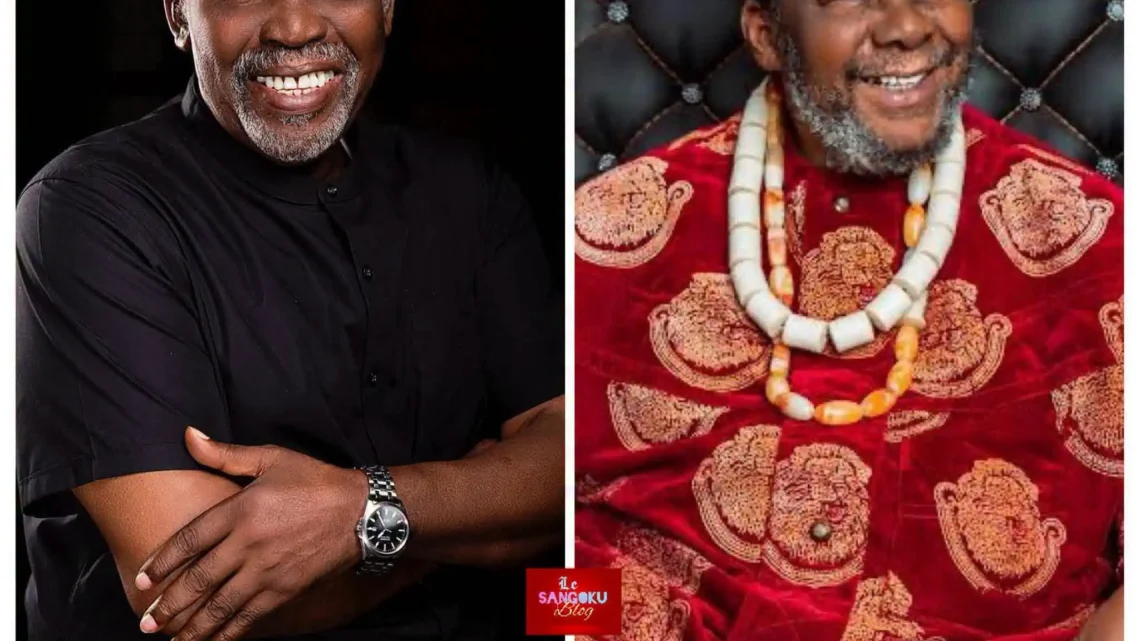
Ten weeks separated the deaths of the two men Nigeria trusted most to play its fathers, its chiefs and its kings. Olu Jacobs died on September 16 at the age of 84, and Pete Edochie followed on November 25 at 79.
Since then, one question has moved through group chats, timelines and family living rooms with unusual heat: which of them was the greater screen patriarch?
Trending Now!!:
The industry has long grouped them, and one national newspaper once called them both godfathers of Nollywood. The tributes now arriving suggest the public is no longer willing to keep them side by side.
Edochie’s claim rests on cultural imprint. He became widely known for playing Okonkwo in the 1987 NTA adaptation of Chinua Achebe’s Things Fall Apart, and the performance followed him into every palace, compound and boardroom he entered afterwards.
His voice, sharpened over years in broadcasting, carried half of every scene before he spoke a line of dialogue. President Olusegun Obasanjo made him a Member of the Order of the Niger in 2003, and when he died, Enugu State Governor Peter Mbah called him an institution.


His defenders argue that no other Nollywood elder is so completely fused with the idea of the African father: stern, eloquent, proud and impossible to ignore.
Jacobs reached the same summit by a harder road. He trained at the Royal Academy of Dramatic Art in England. He began his career in British television series and international films, with credits that include The Dogs of War and Pirates.
He won the Africa Movie Academy Awards prize for Best Actor in a Leading Role in 2007, and he received the Industry Merit Award at the Africa Magic Viewers’ Choice Awards in 2013 and a Lifetime Achievement Award from the Africa Movie Academy Awards in 2016. In Nigeria, he became best known for portraying fathers, chiefs, traditional rulers, politicians and other figures of authority across hundreds of productions.
His admirers add a harder argument: with his wife, Joke Silva, he co-founded the Lufodo Group, and the couple also set up the Lufodo Academy of Performing Arts, which trains new talent. A patriarch who builds the school, they say, outranks one who only owns the throne.
Nothing divides the debate like an old quarrel over the Igwe roles. For years, Edochie was said to have objected to Jacobs, a Yoruba man, portraying an Igbo traditional ruler, and the complaint was often framed as ethnic.
In a 2014 interview, Edochie denied that. He said his problem was that directors never schooled Jacobs in Igbo custom, citing the way a horse whip is held, an Igwe pacing while addressing his cabinet and an Igwe leaving the palace to consult a native doctor instead of summoning one.
He called Jacobs an accomplished actor and a longtime friend, and pointed out that actors cross cultural lines all the time, noting his own turn as an Emir. One camp hears a craftsman defending accuracy. The other hears a gatekeeper deciding who may wear which crown.
Edochie’s final months added another layer. On a podcast, he declared that he began acting at age 15, before Nollywood existed as an industry, and that he had no senior colleague.
The pushback was swift. Lere Paimo said he began professionally in 1958, and Kola Olaiya invoked the legacy of Hubert Ogunde, whose career began in 1944. Bob-Manuel Udokwu insisted he started before Edochie; Yemi Solade made a similar claim, and Kanayo O. Kanayo said he entered the industry first.
Then Jacobs died, and Edochie’s own tribute complicated his campaign. He called Jacobs a brother and the most senior of their peers, and noted that Jacobs outlived most of their senior colleagues by more than a decade past the traditional lifespan. Supporters read generosity. Critics read a man conceding the crown only after the contest had ended.
The two men had also shared an odd fate online. Social media had declared Jacobs dead roughly four times since 2020, and Edochie had “died” several times as well. The real announcements arrived differently. The Jacobs family asked bloggers and influencers to respect their privacy, while Edochie spoke publicly of the six years Silva spent caring for her husband through a long illness.
The public responses diverged too. Tributes for Jacobs came from Atiku Abubakar, Funke Akindele and others, and President Bola Tinubu mourned him.
For Edochie, the first named mourners were Mbah and Akindele, and by early Wednesday Tinubu, Governor Charles Soludo and the Actors Guild of Nigeria had not posted on X. Whether that gap measures greatness or only timing is a debate of its own.
The verdict, then, is an uncomfortable split. If a patriarch is the voice a nation hears when it pictures a father, the throne belongs to Edochie, and no amount of archival argument will move it.
If the title belongs to the man who trained the actors, built the school and carried the craft across continents, it belongs to Jacobs. Nollywood buried both within ten weeks, and its audience still cannot agree on whether it lost a star or a master.